Simple Present Tense Worksheet: Free Practice Exercises With Answers
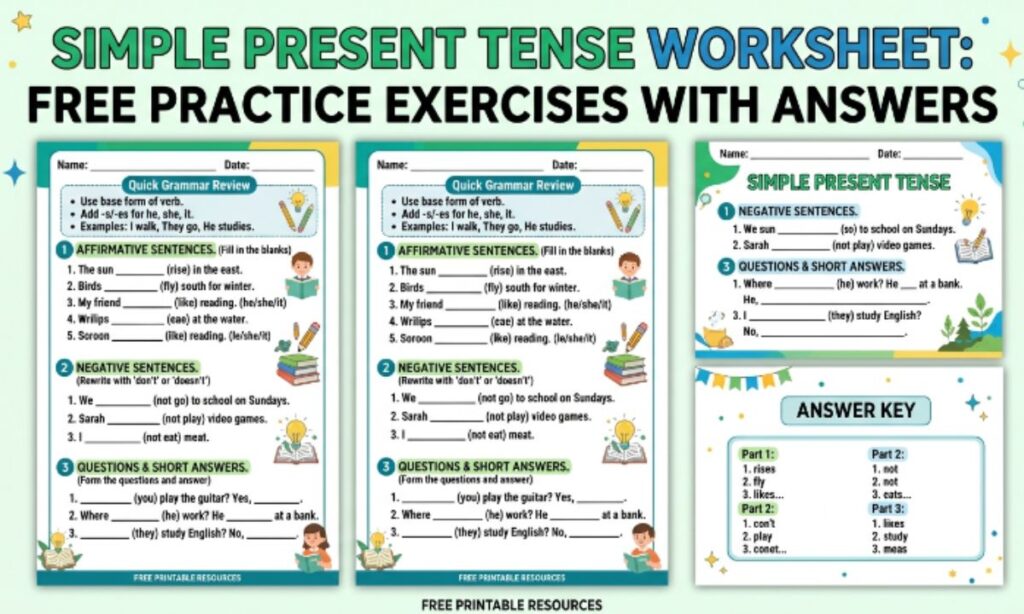
Learning English grammar becomes so much easier when you practice with real exercises instead of just reading rules. That’s exactly why a simple present tense worksheet is one of the most searched resources by students, teachers, and ESL learners across the world. Whether you’re a school student preparing for exams, a parent helping your child with homework, or an English learner brushing up on basics, this worksheet-based guide will help you understand and master the simple present tense quickly.
In this article, you’ll find the complete structure of simple present tense, ready-to-use worksheets with answer keys, tips to avoid common mistakes, and even a simple present tense explanation in Urdu for beginners. Let’s get started.
What Is the Simple Present Tense?

The simple present tense is used to talk about habits, daily routines, facts, and general truths. It’s the tense you use when something happens regularly or is always true — like “The sun rises in the east” or “She drinks tea every morning.”
This tense is usually one of the first grammar topics taught to English learners because it forms the foundation for almost every other tense in the language. Once you understand its structure, learning other tenses becomes much simpler.
Structure of Simple Present Tense
Understanding the sentence structure is the first step before attempting any worksheet. The simple present tense has three main sentence types: affirmative, negative, and interrogative (question) forms.
Affirmative (Positive) Sentences
Formula: Subject + Base Verb (+s/es for third person singular) + Object
| Subject | Verb Form | Example Sentence |
| I / You / We / They | Base verb | I play cricket every evening. |
| He / She / It | Verb + s/es | She plays the piano daily. |
Negative Sentences
Formula: Subject + do/does + not + Base Verb + Object
- I do not (don’t) like spicy food.
- He does not (doesn’t) go to the gym.
Interrogative (Question) Sentences
Formula: Do/Does + Subject + Base Verb + Object?
- Do you drink coffee every morning?
- Does she work on Sundays?
Quick Rules to Remember
- Add -s to verbs for he/she/it (he walks, she runs).
- Add -es after verbs ending in s, x, z, ch, sh (he watches, she fixes).
- Change y to ies when the verb ends in a consonant + y (study → studies).
- Use do/does as helping verbs for negatives and questions.
- Never use “s” on the main verb when “does” is already present (correct: does she play, not does she plays).
Simple Present Tense Worksheet With Answers
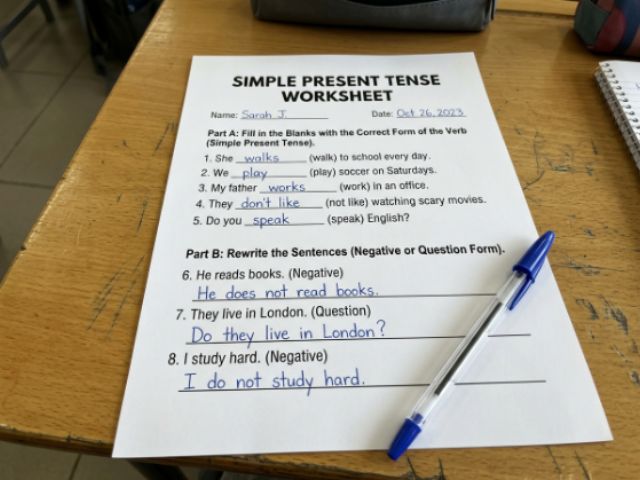
Below is a practical worksheet you can use for classroom teaching, homework, or self-study. It includes fill-in-the-blanks, sentence correction, and question formation — the same exercise types found in most top-rated grammar worksheets.
Read More: Openned or Opened? Which Spelling Is Actually Correct? (Perfect Guide 2026)
Worksheet 1: Questions
Fill in the blanks using the correct form of the verb given in brackets.
- She __________ (wake) up early every day.
- The sun __________ (rise) in the east.
- He __________ (not/watch) TV on weekdays.
- We __________ (play) football on weekends.
- My brother __________ (study) in Class 8.
- They __________ (not/live) in Karachi.
- It __________ (rain) a lot during monsoon.
- You __________ (work) very hard every day.
- The teacher __________ (explain) the lesson clearly.
- Birds __________ (fly) south in winter.
Worksheet 2: Sentence Formation and Questions
Rewrite the following sentences into negative and question forms.
- He speaks four languages.
- They eat lunch in the cafeteria every day.
- She lives with her family.
- I go to bed at 11:00 every night.
- Water boils at 100 degrees Celsius.
Answer Key
Worksheet 1 Answers:
- wakes
- rises
- does not watch
- play
- studies
- do not live
- rains
- work
- explains
- fly
Worksheet 2 Answers (sample negative/question forms):
- Negative: He does not speak four languages. Question: Does he speak four languages?
- Negative: They do not eat lunch in the cafeteria every day. Question: Do they eat lunch in the cafeteria every day?
- Negative: She does not live with her family. Question: Does she live with her family?
- Negative: I do not go to bed at 11:00 every night. Question: Do you go to bed at 11:00 every night?
- Negative: Water does not boil at 100 degrees Celsius. Question: Does water boil at 100 degrees Celsius?
Simple Present Tense Worksheet in Urdu
For beginner learners who understand grammar better with translation support, here is a simplified explanation in Urdu.
Simple Present Tense ka istemal roz mara ke kaamon, adaton, aur general sacchai (facts) ko bayan karne ke liye hota hai. Jaise: “Wo har roz school jata hai” (He goes to school every day).
Structure:
- Subject + Verb (first form) + s/es (he/she/it ke sath) + Object
Misalein (Examples):
- Main roz paani peeta hoon. → I drink water every day.
- Wo cricket khelta hai. → He plays cricket.
- Hum school nahi jate hain (chutti ke din). → We do not go to school (on holidays).
Is tarah ke worksheets Urdu-medium students ke liye bohat madadgar hote hain kyun ke wo pehle concept ko apni zaban mein samajhte hain, phir English mein practice karte hain.
Tips and Tricks to Master Simple Present Tense
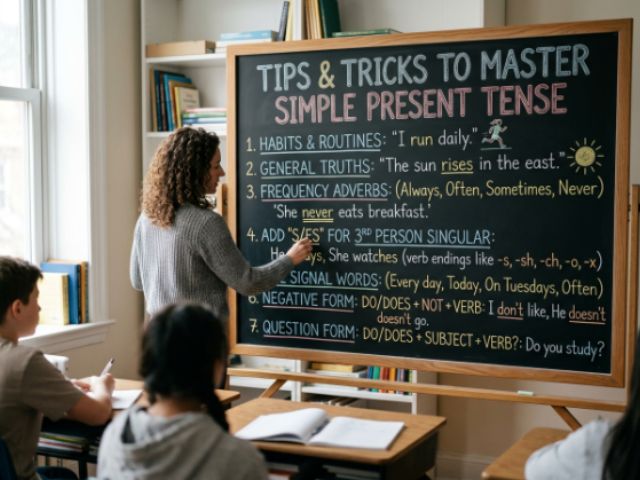
- Focus on subject-verb agreement. This is the most common mistake students make — forgetting to add “s” or “es” for third-person singular subjects.
- Use time markers as clues. Words like always, usually, often, every day, sometimes, never strongly indicate the simple present tense.
- Practice with real-life routines. Write 5 sentences about your own daily schedule to reinforce learning naturally.
- Don’t double the helping verb. Once “do” or “does” is used, the main verb stays in its base form.
- Read sentences aloud. Hearing the correct verb form helps build natural fluency faster than silent reading.
- Practice regularly with worksheets. Repetition through worksheets is proven to improve grammar retention compared to passive reading.
Bonus Exercise: Error Correction
Find and correct the mistakes in the following sentences.
- She go to market every Friday.
- He don’t like tea.
- Does they play chess?
- The train leave at 6 PM.
- I doesn’t understand this topic.
Corrected Answers:
- She goes to market every Friday.
- He doesn’t like tea.
- Do they play chess?
- The train leaves at 6 PM.
- I don’t understand this topic.
Frequently Asked Questions
What is a simple present tense worksheet used for?
It’s a practice tool that helps students apply simple present tense rules through exercises like fill-in-the-blanks, sentence correction, and question formation.
What are the three forms of simple present tense?
The three forms are affirmative (positive), negative, and interrogative (question) sentences.
When do we use “does” instead of “do”?
We use “does” with he, she, it, and singular subjects, while “do” is used with I, you, we, and they.
Can I download a simple present tense worksheet PDF for free?
Yes, most educational and grammar-focused websites offer free printable simple present tense worksheets with answer keys for download.
Is simple present tense the same as present indefinite tense?
Yes, simple present tense is also called present indefinite tense in traditional grammar terminology.
How can I teach simple present tense to beginners easily?
Use daily routine examples, visual time markers (always, usually, every day), and short worksheets to build understanding step by step.
Conclusion
Mastering the simple present tense doesn’t have to be complicated. With a clear understanding of its structure, regular practice using worksheets, and attention to common mistakes like subject-verb agreement, learners can build strong grammar foundations quickly. The worksheets and answer keys shared in this article are designed to be practical, whether you’re a teacher preparing classroom material or a student practicing independently at home.
Keep practicing consistently, review your mistakes using the answer keys, and soon using the simple present tense correctly will become second nature in both your speaking and writing.
Leave a Reply