Openned or Opened? Which Spelling Is Actually Correct? (Perfect Guide 2026)
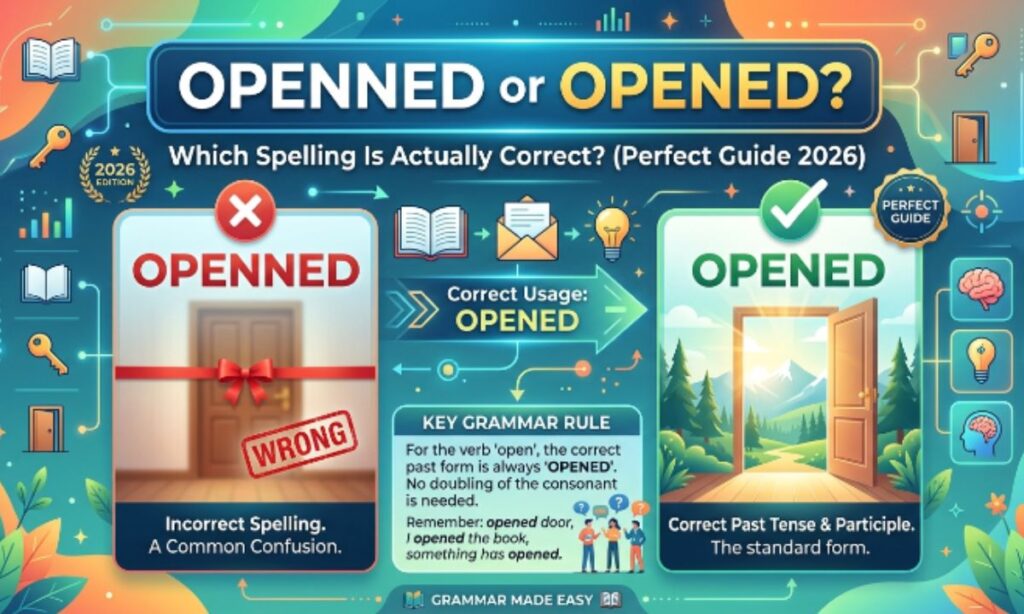
If you’ve ever typed “openned” into an email, text message, or school assignment and then paused with your cursor blinking, wondering if that word actually looks right — you’re in good company. This is one of the most common spelling slips in the English language, and it trips up native speakers and English learners alike.
The confusion isn’t random. English has a genuine rule about doubling consonants before adding “-ed,” and “open” sits right in the middle of that confusing territory. Words like stop become stopped, plan becomes planned, and drop becomes dropped — so it feels logical to assume open should become openned. But it doesn’t.
In this guide, you’ll get a complete, no-fluff breakdown of the correct spelling, the grammar rule behind it, real-world examples, common mistakes, and a simple trick that will make sure you never second-guess yourself again.
Quick Answer
Opened is the correct spelling. Openned is not a real word and does not appear in any standard English dictionary.
Opened is the simple past tense and past participle of the verb open. It’s spelled with a single “n” because the stress in the word “open” falls on the first syllable (OH-pen), not the second. That single detail is the entire reason this word doesn’t double its final consonant.
| Word | Status | Correct Use |
| Opened | ✅ Correct | She opened the door. |
| Openned | ❌ Incorrect | Never used in standard English |
Keep that quick answer in mind, and you’ll never need to second-guess this word again. But if you want to actually understand why — and permanently fix the habit — keep reading.
Meaning of “Opened”
“Opened” is the past tense form of the verb “open.” It describes an action that has already happened, where something moved from a closed, sealed, or inactive state into an accessible, visible, or active one.
In simple terms, “opened” means:
- To make something no longer closed
- To start or begin something (like a store, meeting, or event)
- To unlock, unseal, or uncover something
- To become available or accessible
Examples:
- She opened the door quietly before anyone woke up.
- The store opened at 9 a.m. sharp.
- He opened his laptop and started replying to emails.
- They opened a new branch downtown last month.
Because “open” is a regular verb, its past tense follows the standard formula: verb + -ed. There’s no irregular twist here, and there’s no consonant doubling either — which is exactly where most people go wrong.
Openned or Opened Synonym
If you want to add variety to your writing instead of repeating “opened” over and over, several synonyms work well depending on context:
- Unlocked – she unlocked the cabinet
- Unsealed – he unsealed the envelope
- Launched – the company launched its new store
- Started – the meeting started on time
- Revealed – the curtain revealed the stage
- Initiated – they initiated the ceremony
- Uncovered – she uncovered the hidden documents
Using synonyms doesn’t just make your writing sound more natural — it also helps you avoid over-repeating a word in essays, articles, or professional emails.
The Store Is Open or Opened

This is a separate but related point of confusion. Both “open” and “opened” can be correct here — the meaning simply changes depending on tense and context.
- “The store is open” → describes the current state. The store is currently accessible to customers right now.
- “The store opened at 9 a.m.” → describes a past action. It tells you when the store began operating.
Here’s a simple way to remember the difference:
| Sentence | Tense | Meaning |
| The store is open. | Present (adjective) | It is currently accessible. |
| The store opened at 9 a.m. | Past (verb) | The action of opening happened at 9 a.m. |
| The store has opened for the season. | Present perfect | The action recently occurred and is relevant now. |
So “open” functions as an adjective describing a state, while “opened” functions as a verb describing an action that occurred.
Why People Mistakenly Write “Openned”
This mistake isn’t a random typo — it comes from a real (but misapplied) English spelling pattern. Here’s why so many people fall into this trap:
- Pattern confusion with doubling verbs. English has plenty of verbs that double their final consonant before “-ed” — stop → stopped, plan → planned, drop → dropped, hug → hugged. Since “open” ends in “n” just like “plan,” it’s natural to assume it follows the same rule.
- Muscle memory from fast typing. When typing quickly on a phone or keyboard, it’s easy to accidentally double a letter, especially one your brain half-expects to be doubled anyway.
- Autocorrect and spellcheck gaps. Not every app or browser catches this error immediately, so the mistake can slip through in casual writing like texts, social media captions, or quick emails.
- Lack of awareness about syllable stress. Most people were never explicitly taught the actual rule that governs consonant doubling — so they guess based on similar-looking words instead.
- Non-native English learners applying general -ed rules. Many ESL learners are taught the “add -ed” rule early on, without the more advanced nuance about when to double a final consonant.
Understanding why the mistake happens is often the fastest way to stop making it — once you know the logic, the correct spelling becomes obvious rather than something you have to memorize by rote.
Simple Rule to Remember
Here’s the actual grammar rule, explained in plain English:
You only double the final consonant of a verb before adding “-ed” when the stress falls on the last syllable of the word.
Let’s break that down with real comparisons:
- Stop → one syllable, stress is automatically on it → stopped (doubled)
- Plan → one syllable → planned (doubled)
- Prefer → two syllables, stress on the second syllable (pre-FER) → preferred (doubled)
- Open → two syllables, stress on the first syllable (OH-pen) → opened (NOT doubled)
- Happen → two syllables, stress on the first syllable (HAP-pen) → happened (NOT doubled)
- Listen → two syllables, stress on the first syllable (LIS-ten) → listened (NOT doubled)
- Visit → two syllables, stress on the first syllable (VIS-it) → visited (NOT doubled)
Notice the pattern? “Open,” “happen,” “listen,” and “visit” all behave the same way — because in every case, the stress lands on the first syllable, not the last.
Memory trick: Think of the phrase “open, happen, listen — never double when the stress won’t glisten (on the last one).” Or more simply: if you can’t hear the stress landing on the final syllable when you say the word out loud, don’t double the letter.
Read More: Winning or Wining? The Powerful Spelling Guide 2026
Comparison Table: Openned vs Opened
| Feature | Opened ✅ | Openned ❌ |
| Dictionary status | Valid, standard English word | Not found in any dictionary |
| Grammar rule | Correct application of past tense (-ed) | Incorrect consonant doubling |
| Syllable stress | Matches first-syllable stress rule | Violates the stress-based doubling rule |
| Used in professional writing | Yes, always acceptable | Never acceptable |
| Recognized by spellcheck | Yes | Flagged as an error |
| American English | Correct | Incorrect |
| British English | Correct | Incorrect |
| Formal and academic use | Appropriate | Inappropriate |
Examples in Sentences
Seeing the word in context is often the fastest way to lock in the correct spelling. Here are several examples across different situations:
Everyday situations:
- She opened the fridge and grabbed a bottle of water.
- He opened the window to let in some fresh air.
- I opened my umbrella just as it started raining.
Workplace and business:
- The company opened a new office in Berlin this year.
- We opened the quarterly meeting with a brief update.
- The manager opened the floor for questions.
Digital and tech context:
- She opened the app to check her notifications.
- He opened fifteen browser tabs at once.
- I opened the attachment before realizing it was the wrong file.
Formal or academic writing:
- The committee opened the session with a review of last year’s minutes.
- The researcher opened her presentation with a striking statistic.
In every single one of these sentences, “opened” is the only grammatically correct choice. “Openned” would never fit, no matter how formal or casual the tone is.
Why Opened Not Openned
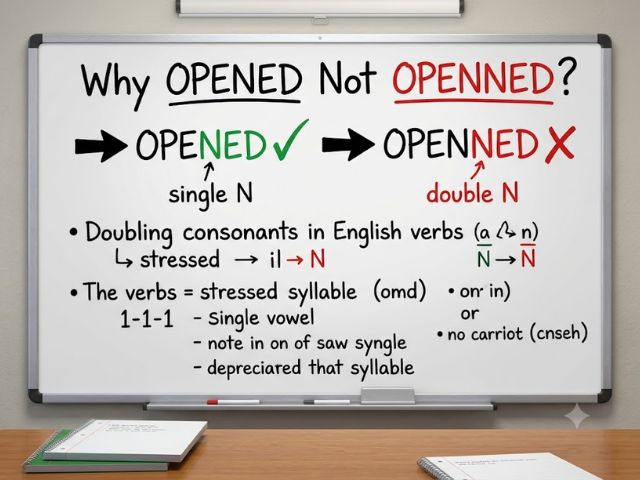
To put it plainly: English past-tense spelling isn’t based on how a word “feels,” but on a consistent rule tied to pronunciation and syllable stress.
Here’s the breakdown one more time, condensed:
- “Open” has two syllables: o-pen
- The stress falls on the first syllable: O-pen
- Because the stress is not on the final syllable, the final consonant (“n”) is not doubled
- Add “-ed” directly to the base word: open + ed = opened
This is the same reason words like enter → entered, offer → offered, and travel → traveled (in American English) don’t double their final consonant either. They all share the same first-syllable stress pattern as “open.”
If English did stress the second syllable of “open” (like it does with “prefer”), then “openned” would actually be correct. But it doesn’t — so it isn’t.
Common Mistakes to Avoid
Even after learning the rule, a few related errors tend to creep back in. Watch out for these:
- Doubling the “n” out of habit — writing “openned” simply because it looks similar to “planned” or “stopped.”
- Confusing “open” and “opened” in context — using the adjective “open” when the sentence actually needs the past-tense verb “opened,” or vice versa.
- Mixing up “opening” and “opened” — remember that “opening” is the present participle (an ongoing action), while “opened” refers to a completed one.
- Assuming British and American English spell it differently — they don’t. Unlike words such as colour/color or travelled/traveled, “opened” is spelled identically everywhere.
- Trusting autocorrect blindly — most spellcheckers do catch “openned,” but not always in every app, especially on mobile keyboards with aggressive predictive text.
- Forgetting subject-verb agreement in sentences — for example, writing “She open the door yesterday” instead of “She opened the door yesterday.”
American vs British English Differences
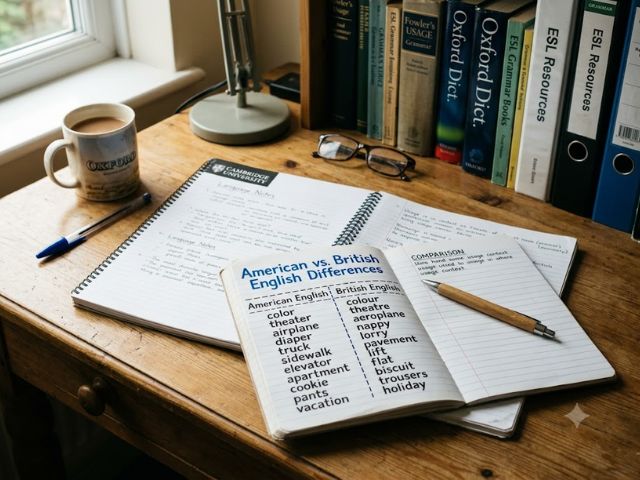
Good news here: there’s no difference at all. Unlike many other English words that shift spelling depending on region — such as color/colour, organize/organise, or traveled/travelled — “opened” is spelled the exact same way in both American and British English.
| Word | American English | British English |
| Opened | Opened | Opened |
| Color | Color | Colour |
| Traveled | Traveled | Travelled |
| Organize | Organize | Organise |
So no matter which side of the Atlantic you’re writing for, “opened” never changes. This makes it one of the more consistent past-tense verbs in the entire language.
Related Forms of “Open”
Understanding how “open” changes across different grammatical forms can help reinforce why “opened” only ever uses a single “n.”
| Form | Word | Example |
| Base form | Open | I open the store every morning. |
| Present tense (3rd person) | Opens | She opens the store every morning. |
| Past tense | Opened | She opened the store yesterday. |
| Past participle | Opened | She has opened the store many times. |
| Present participle | Opening | She is opening the store right now. |
| Adjective | Open | The store is open. |
| Noun | Opening | The store has a job opening. |
Notice that every single form keeps just one “n.” There isn’t a single grammatically correct form of “open” anywhere that doubles the consonant. This consistency is one more reason “openned” never fits.
Synonyms for “Opened”
Varying your vocabulary helps your writing feel more natural and less repetitive — especially in essays, articles, or professional communication. Here are useful alternatives depending on context:
- Unlocked – for doors, boxes, or devices
- Unsealed – for envelopes, packages, or containers
- Launched – for businesses, products, or events
- Initiated – for formal meetings or processes
- Began – for events or activities
- Revealed – for something previously hidden
- Unveiled – for announcements or reveals
- Started – for general activities or operations
- Inaugurated – for formal openings, like buildings or institutions
Example swaps:
- “She opened the ceremony” → “She inaugurated the ceremony.”
- “The company opened its doors in 2020” → “The company launched in 2020.”
- “He opened the box carefully” → “He unsealed the box carefully.”
Openned or Opened Grammar
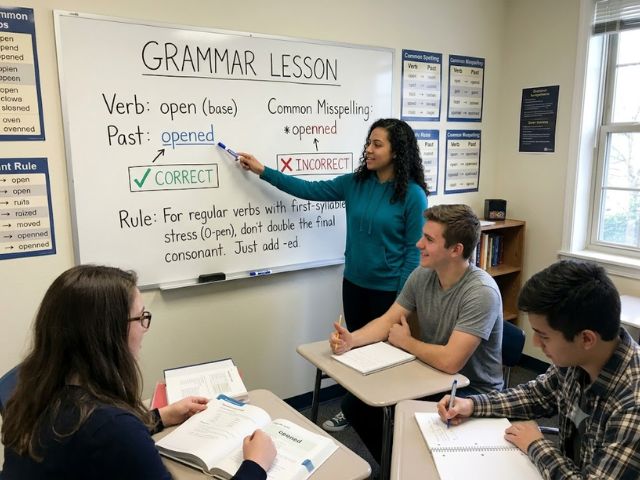
From a pure grammar standpoint, here’s what you need to know:
- “Open” is a regular verb, meaning it follows the standard past-tense pattern of adding “-ed” without any irregular changes.
- The past tense and past participle are identical: both are “opened.”
- This means “opened” is used both in simple past sentences (“She opened the door”) and in perfect tense sentences (“She has opened the door”).
- “Openned” has no grammatical standing whatsoever — it isn’t a recognized irregular form, a dialectal variation, or an accepted alternative spelling in any English-speaking region.
Quick grammar summary:
| Grammar Element | Correct Form |
| Simple past | opened |
| Past participle | opened |
| Present participle | opening |
| Passive voice example | The door was opened by her. |
| Perfect tense example | She has opened the store. |
Mini Spelling Test (Try Yourself)
Test your understanding with these quick fill-in-the-blank sentences. Choose the correct spelling for each:
- She ______ the window before leaving for work. (opened / openned)
- The new mall ______ last weekend. (opened / openned)
- He has already ______ three emails today. (opened / openned)
- They ______ a new restaurant downtown. (opened / openned)
- I ______ my textbook to page 42. (opened / openned)
Answer key: Every single blank should be filled with opened. If you got all five right, you’ve fully locked in the rule.
Why Correct Spelling Matters
It might seem like a small detail, but spelling accuracy carries real weight in how your writing is perceived:
- Professional credibility – A misspelled word like “openned” in a work email or resume can make writing look careless, even if the content itself is strong.
- Academic accuracy – Teachers and professors often deduct points for basic spelling errors, regardless of how good the ideas are.
- Clear communication – Spelling mistakes can slow down a reader or create momentary confusion, especially in formal or technical writing.
- SEO and content quality – For bloggers, marketers, and website owners, consistent correct spelling improves readability scores and keeps readers engaged longer.
- First impressions – Whether it’s a cover letter, a business proposal, or a social media post, small spelling slips can quietly undermine trust.
Getting details like this right is a small effort that pays off in how competent and polished your writing appears.
Frequently Asked Questions
Is “openned” ever correct in any context?
No. “Openned” is not a recognized word in any dictionary or standard form of English, formal or informal.
Why isn’t the “n” doubled in “opened”?
Because the stress in “open” falls on the first syllable, not the last, so English spelling rules don’t require doubling the final consonant.
Is “opened” the same in American and British English?
Yes. Unlike many other words, “opened” is spelled identically in both American and British English.
What part of speech is “opened”?
“Opened” is a verb — specifically the past tense and past participle form of “open.”
Can “open” be used as an adjective?
Yes. For example, “The store is open” uses “open” as an adjective describing a current state.
What’s the present participle of “open”?
The present participle is “opening,” as in “She is opening the store right now.”
Does spellcheck always catch “openned”?
Most modern tools flag it, but not universally across every app, so it’s best to know the rule yourself.
Is “open” a regular or irregular verb?
“Open” is a regular verb, meaning its past tense is formed simply by adding “-ed.”
Conclusion
The debate between “openned” and “opened” really comes down to one simple grammar rule: English only doubles a final consonant before “-ed” when the stress lands on the last syllable — and “open” doesn’t work that way. Since the stress sits on the first syllable (OH-pen), the correct past tense is formed by simply adding “-ed,” giving you opened, with a single “n.”
Now that you understand not just what the correct spelling is, but why it’s correct, this is one spelling mistake you won’t need to worry about again. Whether you’re writing a quick text message, a professional email, an academic paper, or a blog post, remember the simple formula: open + ed = opened, never openned.
Leave a Reply