

You’re scrolling through a group chat, and someone drops it: “lwk kinda miss him.” No punctuation, no explanation, just three lowercase letters sitting there like you’re supposed to already know what they mean.
If you paused and thought, “Wait, is that a typo?” you’re not alone. Search interest in “lwk meaning in text” has spiked hard over the past year, driven mostly by TikTok comment sections, Snapchat streaks, and group chats where full sentences feel like too much effort.
This guide breaks down exactly what “lwk” means, where it came from, how it’s actually used across different apps, and how to reply without sounding out of touch. No jargon, no fluff, just a clear answer and the context to back it up.
What does “lwk” Mean in Text?
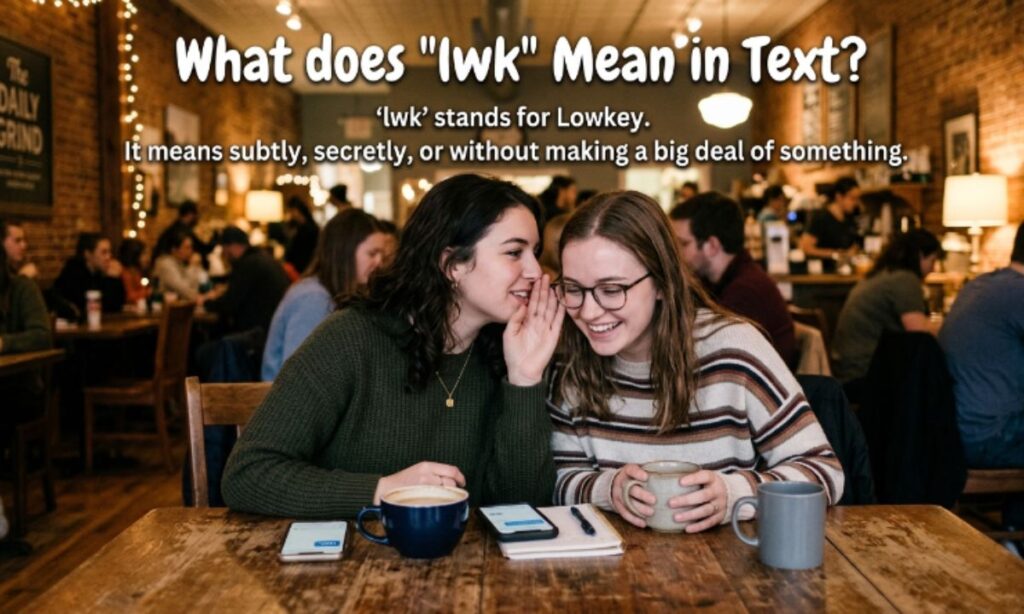
“lwk” is texting shorthand for “low-key.” It’s used to soften a statement — to admit a feeling, opinion, or fact without making a big deal out of it.
Think of it as the texting equivalent of saying “kind of,” “a little,” or “not gonna lie, but quietly.” When someone says:
“I’m lwk nervous about tomorrow.”
They mean they’re nervous, but they’re downplaying it not shouting it, not dramatizing it, just quietly admitting it’s true.
The word “low-key” has been part of spoken English for decades as an adjective (a “low-key event” means a relaxed, understated one). Texting culture flipped it into an adverb-style filler word, then Gen Z slang trimmed it down to four letters for speed. That’s the short version. Here’s the fuller picture.
Quick Answer (Featured Snippet Style)
| Question | Answer |
| What does lwk stand for? | Low-key |
| What does it mean? | Something subtle, quiet, understated, or secretly true |
| Is it rude? | No, it’s casual and neutral |
| Where is it used? | Texting, TikTok, Snapchat, Instagram, Discord, X |
| Who uses it most? | Gen Z and younger Millennials |
| Formal or informal? | Strictly informal |
LWK Meaning Medical
This one trips people up because “LWK” also shows up in medical and clinical documentation, and it means something completely different there.
In a medical or nursing context, LWK typically stands for “left wrist,” “left kidney,” or is occasionally used as shorthand within specific hospital charting systems, depending on the department and institution. Medical abbreviations are notoriously inconsistent between hospitals, so LWK in a chart note isn’t a universal standard — it’s institution-specific shorthand, and its exact meaning always depends on the surrounding clinical context (an orthopedic note vs. a renal one, for example).
The key takeaway: if you saw “LWK” in a text message from a friend, it almost certainly means “low-key.” If you saw it in a doctor’s note, a discharge summary, or a lab report, it’s referring to anatomy — not a mood. Context is everything with this abbreviation, and that’s true across every meaning on this list.
The Most Common Meanings of “lwk”
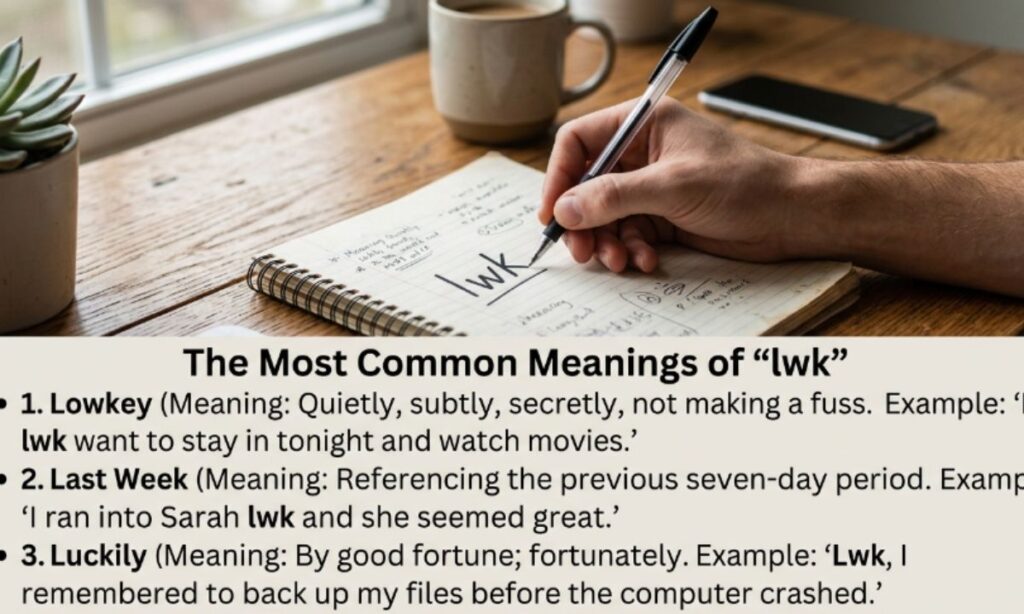
“lwk” isn’t a one-trick abbreviation. While “low-key” dominates by a wide margin, a handful of alternate meanings pop up depending on the app, the sender’s age, and the sentence around it.
| Meaning | How Common | Typical Context |
| Low-key (subtle/quiet feeling) | Very common (90%+ of uses) | Texting, TikTok, Snapchat, Instagram |
| Love with kisses | Rare | Sign-offs in personal/romantic texts |
| Last week | Occasional | Casual WhatsApp or SMS chats |
| Light work / Let’s work | Niche | Gym, hustle, or motivational content |
| Left wrist / Left kidney | Medical only | Clinical charts and notes |
1. Low-Key (the dominant meaning)
This is what you’ll encounter 9 times out of 10. It expresses:
- A quiet or secret feeling (“I’m scared of spiders”)
- An understated opinion (“lwk think that movie was mid”)
- A mild admission (“I didn’t study for the test”)
2. Love With Kisses
Occasionally seen as a sign-off in affectionate or romantic texts, similar to “xoxo.” It’s uncommon and almost always obvious from context, usually at the end of a message rather than in the middle of a sentence.
3. Last Week
In some casual conversations, particularly in the UK and among older texters, “lwk” is shorthand for “last week.” This use is far less frequent than “low-key” but does appear, especially in scheduling-related texts like “saw that lwk.”
4. Light Work / Let’s Work
In fitness and hustle-culture spaces, “lwk” occasionally stands in for phrases like “light work” (something easy) or “let’s work” (a call to grind). This usage is niche and mostly confined to specific communities like gym TikTok.
How “lwk” Is Used in Real Conversations
Here’s where the abbreviation actually earns its popularity: it’s flexible. People use “lwk” to soften confessions, add humor, or admit something without fully committing to it emotionally.
Real examples:
- “lwk this song slaps” I secretly/quietly think this song is really good
- “I’m lwk stressed about finals”. I’m somewhat stressed, not spiraling
- “I kinda miss her,” admitting a feeling while downplaying its intensity
- “I think I bombed that interview,” a soft confession, said casually
- “lwk this is kinda funny” reacting without full commitment to how funny it is
Notice the pattern: “lwk” almost always sits at the front of a sentence or clause, right before the actual feeling or opinion. It works like a verbal cushion; it takes the edge off whatever comes next.
Where You’ll See It Most
- TikTok comments: reacting to videos without sounding overly enthusiastic
- Snapchat captions: casual, unfiltered thoughts
- Instagram DMs and captions: soft confessions or opinions
- Group chats: quick, low-effort honesty
- Discord servers: gaming and community banter
Is “lwk” Rude, Flirty, or Offensive?
Short answer: no, it’s neither rude nor offensive. “lwk” is a neutral, casual filler word. It doesn’t carry insult, aggression, or negativity on its own.
That said, tone depends heavily on context:
- Neutral use: “lwk hungry rn” is just a casual statement, with no emotional weight.
- Flirty use: “lwk you’re kinda cute.” This is where it gets playful. Adding “lwk” before a compliment softens it just enough to feel low-pressure and safe, which is exactly why it’s popular in flirty texting. It lets someone test the waters without fully committing to the compliment.
- Sarcastic use (rare): In a serious or tense conversation, using “lwk” dismissively could come across as minimizing someone’s feelings, but this is about tone and timing, not the word itself.
The general rule: “lwk” is almost never used to hurt or offend. It’s a softening tool, not a sharp one. If a message feels off, it’s usually the surrounding words or the relationship dynamic causing that, not the abbreviation.
Read More: GNG Meaning in Text: The Ultimate 2026 Guide to This Viral Chat Slang You Keep Seeing Everywhere
How to Respond When Someone Says “lwk”
You don’t need to overthink a reply. Since “lwk” softens whatever follows it, your response should usually match that same low-pressure energy.
A few solid approaches:
- Mirror the tone; respond casually, without making it a big deal.
- Them: “lwk missed you” → You: “lwk missed you too 🤍”
- Engage with the actual content, not the abbreviation; reply to the feeling or opinion they shared.
- Them: “lwk think I failed that test” → You: “nah, you’re overthinking it, you’ll be fine”
- Ask a light follow-up if you want more detail.
- Them: “lwk this trip was kinda mid” → You: “wait really? What happened”
- Use it back if it fits naturally: this signals you’re on the same wavelength.
There’s no need to “translate” it out loud or point out that you know what it means just respond like you would to any casual, honest statement.
Common Misunderstandings About “lwk”
A few mix-ups happen regularly, especially for people newer to texting slang:
- Confusing it with “lol” or “lmao.” These are laughter-based reactions. “lwk” carries no built-in humor; it’s about subtlety, not amusement.
- Assuming it’s always emotional or deep. Sometimes “lwk” just precedes something mundane, like “lwk hungry”; it doesn’t always signal a confession.
- Thinking it’s rude when it’s actually softening something. Because it’s blunt in appearance (all lowercase, no punctuation), some readers misread the tone as cold. In reality, it usually makes a statement gentler, not harsher.
- Mixing up “lwk” with “hwk” (high-key). These are near-opposites. “Low-key” downplays a feeling; “high-key” (hwk) amplifies it. “hwk obsessed with this show” means fully, openly obsessed, the opposite energy of “lwk.”
- Not recognizing the medical meaning in clinical contexts. As covered above, this is a completely separate, unrelated use.
Similar Slang Terms You Should Know
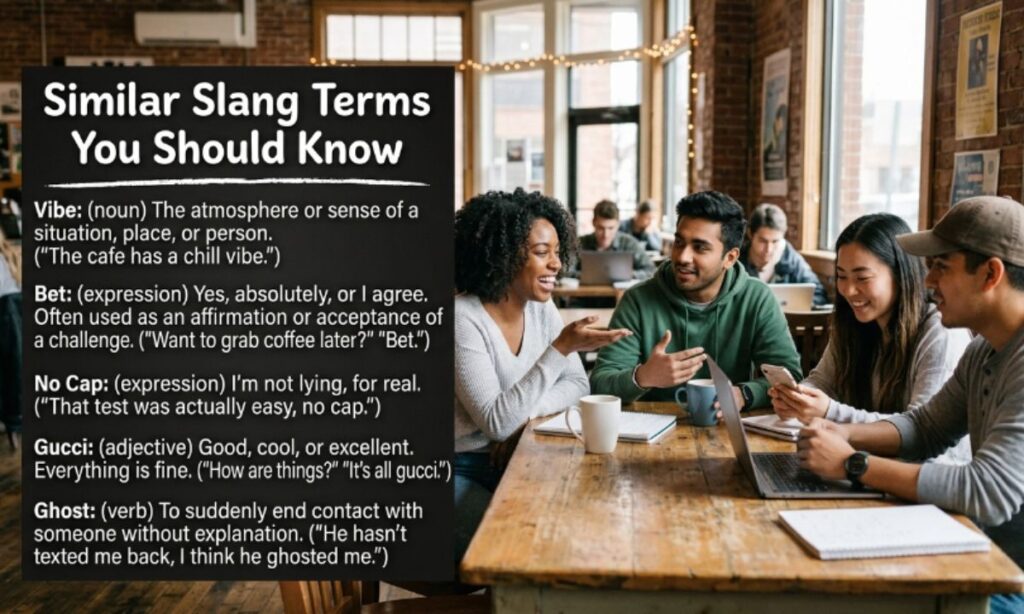
“lwk” belongs to a small family of tone-softening or tone-shifting abbreviations that show up constantly in the same conversations.
| Slang | Meaning | Example |
| lwk | Low-key (subtle/quiet feeling) | “lwk tired” |
| hwk | High-key (obvious/strong feeling) | “hwk obsessed with this” |
| ngl | Not gonna lie | “ngl that was funny” |
| tbh | To be honest | “tbh I don’t care” |
| ikr | I know, right | “ikr that’s wild” |
| fr | For real | “fr though, same” |
| rn | Right now | “busy rn” |
| ong | On God (I swear) | “ong I didn’t do it” |
Knowing this cluster of terms makes it much easier to read casual texts fluently, since they often appear stacked together in the same sentence (e.g., “ngl lwk kinda miss the old days fr”).
When You Should Avoid Using “lwk”
“lwk” is casual internet slang, which means it has clear boundaries. Avoid it in:
- Professional emails or workplace Slack messages: it reads as unpolished in formal settings.
- Job applications, cover letters, or resumes are always inappropriate here.
- Customer service or business texting: clarity matters more than a casual tone when representing a brand.
- Academic writing: essays, reports, and papers should use full words.
- Conversations with people unfamiliar with internet slang: older relatives, new coworkers, or anyone outside your usual texting circle might not know the term, leading to confusion instead of connection.
In these situations, simply use the full word “low-key,” or better yet, express the sentiment in plain language: “I’m a little nervous about this” instead of “lwk nervous.”
Frequently Asked Questions
What does “lwk” mean in text?
It means “low-key” used to express a feeling, opinion, or fact in a subtle, understated way.
Is “lwk” the same as “low-key”?
Yes. “lwk” is simply the shortened, faster-to-type version of “low-key.”
Does “lwk” ever mean something other than low-key?
Occasionally. It can mean “love with kisses,” “last week,” or, in medical charts, refer to anatomy like “left wrist.” Context decides which meaning applies.
Is “lwk” flirty?
It can be, especially before a compliment — it softens the statement and makes it feel lower-pressure.
Is “lwk” rude or offensive?
No. It’s a neutral, casual softening word, not an insult.
What’s the opposite of “lwk”?
“hwk,” short for “high-key,” which means something obvious, strong, or fully embraced rather than subtle.
Should I use “lwk” in professional messages?
No. It’s strictly casual and shouldn’t appear in emails, resumes, or workplace communication.
Where did “lwk” come from?
It’s a texting abbreviation of the older slang term “low-key,” trimmed down for speed and popularized through social media platforms like TikTok, Snapchat, and Instagram.
Who uses “lwk” the most?
Primarily Gen Z and younger Millennials, especially in texting and short-form social media comments.
How do I reply when someone texts me “lwk”?
Respond to the actual feeling or opinion they shared, and keep your tone just as casual and low-pressure as theirs.
Final Thoughts
“lwk” isn’t complicated once you see it in context; it’s a small, casual word that does one job well: softening whatever comes after it. Whether someone’s admitting they’re nervous, dropping a flirty compliment, or just reacting to a meme, “lwk” lets them say it without making it feel like a big deal.
Now that you know what it means, where it shows up, and how to respond, you won’t have to pause and wonder the next time it lands in your messages. Use it casually, keep it out of formal writing, and you’re set.
