Poison Tree Tattoo Meaning: Symbolism, History & What It Represents
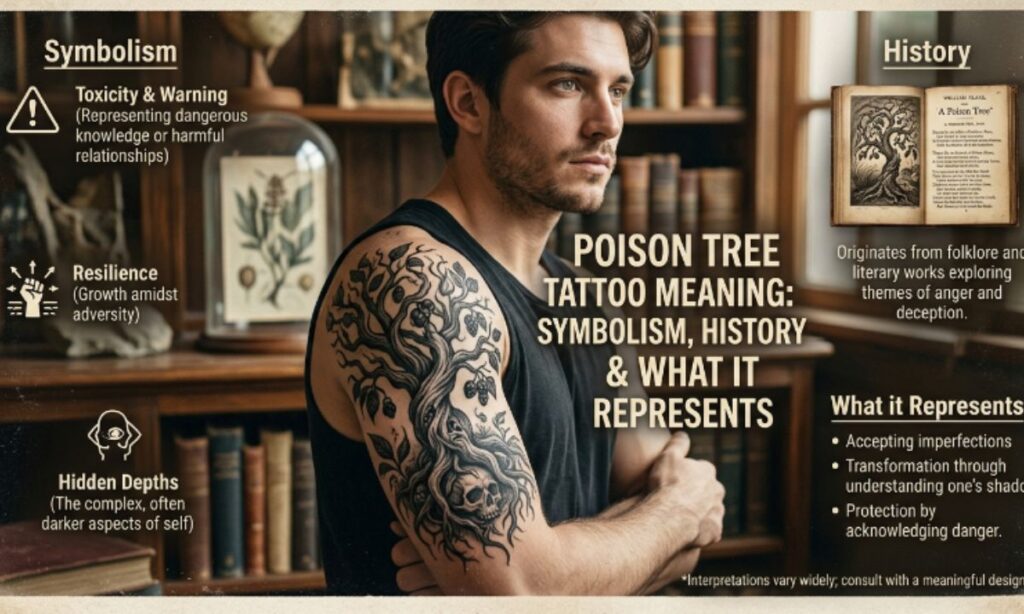
Some tattoos are chosen for how they look. Others are chosen for what they carry. The poison tree tattoo belongs firmly in the second category. At first glance, it’s a dark, twisted tree bare branches, gnarled roots, maybe a strange piece of fruit hanging low. But underneath that image sits one of the most emotionally loaded tattoo concepts in modern body art: the idea that anger, when it’s never spoken, doesn’t vanish. It grows.
This guide breaks down everything behind the design where it comes from, what it symbolizes, how artists interpret it, and why so many people choose it to mark a chapter of their lives they’re finally ready to let go of.
What Does a Poison Tree Tattoo Actually Symbolize?

At its core, a poison tree tattoo represents suppressed emotion usually anger, resentment, or betrayal that has been left to grow instead of being released. It’s built on a simple but unsettling idea: what you don’t say out loud doesn’t disappear. It just changes shape.
The tattoo typically speaks to one or more of these themes:
- Hidden anger that builds quietly instead of being expressed
- Betrayal or broken trust, often tied to a specific relationship or friendship
- Emotional honesty, as a lesson learned the hard way
- Personal transformation, moving from bitterness toward self-awareness
- The end of a toxic relationship, romantic, familial, or platonic
What makes this design different from most “dark” tattoos is that it isn’t really about darkness for its own sake. It’s a mirror. People get it after they’ve been through something not to celebrate the pain, but to mark that they survived it and understood it.
Unlike tattoos with a single fixed meaning, this one shifts depending on who’s wearing it. For some, it’s a warning to themselves about what silence can do. For others, it’s already in the rearview mirror a symbol of a battle they’ve already won.
The Origins of the “Poison Tree” Idea in Literature and Folklore
The concept of a tree that produces something dangerous instead of something nourishing isn’t new. Long before it became a tattoo trend, it showed up across mythology, religion, and folklore as a way to talk about temptation, hidden danger, and moral consequence.
A few notable examples:
| Tradition | Symbolic Meaning of the Poisonous Tree/Fruit |
| Christian symbolism (Garden of Eden) | Forbidden knowledge, temptation, the fall from innocence |
| Greek mythology (Hesperides’ golden apples) | Beauty that guards danger; something precious worth protecting or fearing |
| Persian and Middle Eastern folklore | Betrayal hidden behind an attractive surface |
| Renaissance art | Corrupted fruit as a symbol of moral decay or secret sin |
| Norse and Northern European myth | Trees as living records of fate, growth, and consequence |
Across nearly every version of this idea, the pattern repeats: something that looks appealing on the outside is quietly dangerous underneath. That tension between beauty and threat is exactly why the image translates so well into tattoo art it’s visually striking and symbolically loaded at the same time.
William Blake’s “A Poison Tree” and Its Lasting Influence
While the broader idea of a poisonous tree spans centuries of storytelling, the specific phrase “poison tree” that shows up in tattoo culture today comes from one source: William Blake’s 1794 poem A Poison Tree, published in his collection Songs of Experience.
The poem is short only four stanzas but its message is direct. The narrator describes being angry at a friend, telling him about it, and watching the anger disappear. Then the narrator describes being angry at an enemy, saying nothing, and instead “watering” that anger in secret with fear, fake smiles, and quiet resentment. The anger grows into a tree. The tree produces a shining, tempting apple. The enemy sneaks in, eats the fruit, and dies.
Blake wasn’t writing a literal warning about poisoned fruit. He was describing what happens psychologically when resentment is never released. Communication defuses anger. Silence feeds it. That’s the entire engine behind the poem, and it’s the exact idea tattoo wearers are referencing when they get this design.
A few reasons the poem continues to resonate almost 250 years later:
- It’s short and visual, which makes it easy to translate into a single image rather than needing paragraphs of context.
- The metaphor is universal. Almost everyone has experienced the difference between confronting a problem and burying it.
- It doesn’t moralize loudly. Blake shows the consequence rather than lecturing about it, which leaves room for personal interpretation.
- It fits Romantic-era themes raw emotion, inner conflict, and the human shadow side that still feel relevant today.
Some wearers go a step further and include a short line from the poem itself, most commonly referencing the imagery of the anger growing “night and day” until it bore fruit. Even without the text, though, the tree alone is enough to carry the reference for anyone familiar with the poem.
Poison Tree vs. Tree of Life: Two Opposite Meanings
Tree tattoos are common, but not all trees mean the same thing. It helps to understand how the poison tree stands in direct contrast to one of the most popular tree designs out there: the Tree of Life.
| Feature | Poison Tree Tattoo | Tree of Life Tattoo |
| Core meaning | Suppressed anger, hidden resentment, emotional damage | Growth, family, interconnectedness, balance |
| Visual style | Twisted, bare, or gnarled branches; dark fruit | Full, symmetrical branches; often circular roots |
| Emotional tone | Dark, introspective, sometimes unsettling | Warm, grounding, hopeful |
| Common colors | Black, deep red, grey, muted tones | Green, gold, earthy or vibrant tones |
| Typical wearer intent | Processing pain, marking transformation after hardship | Celebrating heritage, family, or personal growth |
| Fruit symbolism (if present) | Temptation, consequence, hidden danger | Abundance, fertility, prosperity |
The Tree of Life says, “I am connected to everything that came before me and everything still growing.” The poison tree says, “Something painful grew inside me, and I’m not hiding it anymore.” Both are about growth but one grows toward connection, and the other grows out of something that was never allowed to be spoken.
Interestingly, some people intentionally get a poison tree design that shows early signs of healing a single green leaf, a small bud on an otherwise dead branch to symbolize the shift from one meaning toward the other.
Common Design Styles for Poison Tree Tattoos
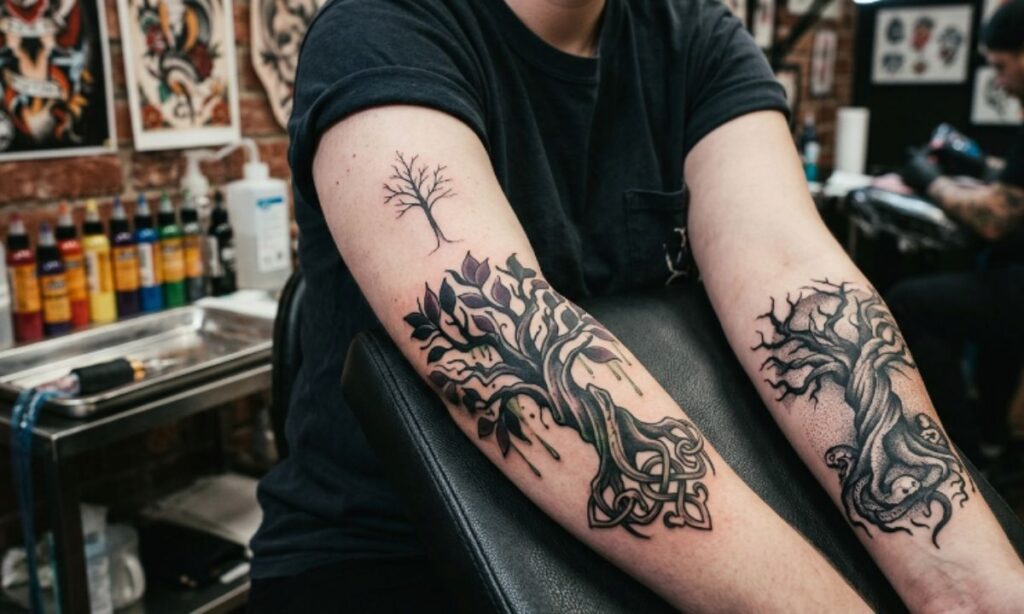
Poison tree tattoos aren’t locked into one artistic style. The theme is flexible enough to work across several tattoo techniques, each of which shifts the tone of the piece slightly.
Popular styles include:
- Blackwork/Gothic : Heavy black shading, sharp branch angles, high contrast. This is the most common style because it visually reinforces the “dark and dangerous” feeling of the concept.
- Illustrative/Neo-traditional : Incorporates storytelling elements directly from Blake’s poem, like an apple, a serpent, or a hidden figure lurking near the roots.
- Realism : Focuses on rendering an actual poisonous or twisted-looking tree species with high botanical detail, letting the danger feel more literal.
- Watercolor : Uses bleeding, fluid color transitions (often deep reds, purples, or inky blacks) to represent emotional complexity rather than a clean, contained feeling.
- Minimalist/Fine-line : Simple linework, often just the silhouette of a twisted tree, appealing to people who want the meaning without a large, heavily shaded piece.
- Abstract : Bold lines and unconventional color choices used to represent emotional intensity rather than a literal tree.
Many designs also blend in secondary imagery to deepen the story:
- A serpent coiled at the base, referencing temptation and hidden danger
- Skulls or bones worked into the roots, symbolizing consequence
- Thorns climbing the trunk, representing pain that comes with holding on to resentment
- Birds, often shown flying away from the tree, symbolizing release or the beginning of healing
What the Apples (or Fruit) on the Tree Represent
The fruit is arguably the most important single detail in a poison tree tattoo, because it’s the moment in Blake’s poem where the metaphor becomes real. The anger isn’t just an idea anymore it’s something that can actually cause harm.
In tattoo symbolism, the fruit generally represents:
- The final product of unspoken anger : proof that what started as a feeling became something dangerous
- Temptation : something that looks appealing but carries hidden risk
- Consequence : the price paid for choosing silence over honesty
- A trap : echoing the poem’s ending, where the fruit is what finally draws the “enemy” in
Design choices around the fruit change the emotional weight of the piece:
- A single glowing or brightly colored apple against dark branches creates visual tension between beauty and danger the exact contrast Blake described.
- Black or rotting fruit leans harder into decay and warning.
- Multiple pieces of fruit can represent repeated cycles of unresolved conflict rather than one isolated event.
- A fallen or bitten apple on the ground beneath the tree often symbolizes that the consequence has already happened the story is being told in the past tense.
Some wearers skip the apple altogether and use thorns, dark berries, or unusual growths instead, especially if they want to reference the theme without directly quoting Blake’s imagery.
Roots, Branches, and Leaves: Reading the Details
Every part of a poison tree tattoo can carry its own layer of meaning, which is part of why the design feels so personal to the people who choose it.
Roots
Roots typically represent the origin of the emotion the initial hurt, betrayal, or trigger that started everything. Roots that look aggressive or tightly gripping the ground often symbolize how deeply the emotion took hold before it was ever addressed. Some designs extend the roots subtly onto the hand or wrist, suggesting the feeling still has a grip on the wearer, whether they want it to or not.
Branches
Branches usually stand in for the different directions unspoken emotion can grow. Twisted, sharp, or asymmetrical branches emphasize how disorganized and unpredictable suppressed anger can become. Bare branches without leaves often represent isolation or the emotional cost of staying silent for too long.
Leaves
Leaves are where the tattoo can lean toward hope instead of pain. Falling or decaying leaves reflect emotional exhaustion or loss. A few fresh green leaves on an otherwise bare tree, though, are a popular way to hint at healing proof that growth is still possible even after something toxic took root.
Bark texture
Cracked, splitting bark is a common way artists visually represent inner turmoil something breaking apart from pressure that built up on the inside.
Color Choices and What They Add to the Meaning
Color is one of the easiest ways to shift the emotional tone of a poison tree tattoo without changing the composition at all.
| Color | Common Symbolic Association |
| Black | Suppressed emotion, secrecy, mourning, the “hidden” nature of the anger |
| Deep red | Anger, danger, passion, blood-related consequence |
| Grey | Emotional numbness, ambiguity, unresolved feelings |
| Dark purple | Betrayal, mystery, inner conflict |
| Muted green | Slow healing, growth beginning after damage |
| Bright/glowing accents | Temptation, the “trap” quality of the fruit |
Most poison tree tattoos stay within a limited, muted palette on purpose. A tightly controlled color scheme reinforces the feeling of something contained and hidden, which mirrors the poem’s central idea. Wearers who want to signal healing often introduce a single unexpected color—a touch of green, gold, or white as a visual break from the darker tones surrounding it.
Read More: JFC Meaning in Text: What Does JFC Mean? Slang Definition & Examples (2026)
Popular Placement Ideas for This Tattoo
Placement plays a real role in how a poison tree tattoo is read, both by the wearer and by anyone who sees it.
- Forearm : Highly visible and hard to hide, often chosen by people who want their story to be seen rather than tucked away.
- Back (full or partial) : A larger canvas that works well for detailed designs; often interpreted as something the wearer has “left behind.”
- Chest : Places the emotional weight close to the heart, a common choice for tattoos tied to personal or relational pain.
- Spine : Considered a more symbolic, almost spiritual placement, aligning the design with the body’s core.
- Sleeve piece : Works well for people building out a larger narrative across multiple tattoos.
- Wrist or finger : Smaller, more discreet versions for people who want personal meaning without a large visible piece.
- Ribs or side : A more private placement, chosen by people who want the meaning to stay personal rather than public.
There’s no single “correct” placement. Visible spots tend to signal that the wearer is comfortable being open about their story, while more concealed placements often suggest the meaning is meant to stay private.
Poison Tree Tattoos in Pop Culture and Media

While the poison tree tattoo isn’t tied to one specific celebrity or franchise the way some tattoo trends are, its cultural footprint comes largely from three overlapping sources:
- Literary tattoo culture Poetry-based tattoos have grown steadily in popularity, and Blake’s compact, image-driven poem is one of the most tattoo-friendly texts in the English literary canon.
- Gothic and dark-aesthetic art movements Twisted trees, forbidden fruit, and shadowy botanical imagery show up frequently in gothic illustration, album art, and alternative fashion, which has helped normalize the visual style.
- Therapy and mental health conversations online As more people talk openly about suppressed emotion, emotional labor, and boundary-setting, Blake’s poem has resurfaced in therapy-adjacent spaces as a metaphor for what happens when people avoid confrontation. That renewed relevance has fed directly back into tattoo culture.
Because the symbolism is so flexible, the design tends to spread through word of mouth and tattoo portfolios rather than a single viral moment people see it, recognize the feeling behind it, and connect it to their own experience.
Who Typically Gets a Poison Tree Tattoo and Why
There’s no single “type” of person who chooses this tattoo, but a few common threads show up again and again among people who get it.
People who often choose this design:
- Those who’ve come out of a toxic relationship, friendship, or family dynamic
- People who’ve dealt with betrayal and want a permanent reminder of what they learned from it
- Readers and literature lovers who want a meaningful literary tattoo rather than a generic quote
- Individuals working through therapy or emotional healing, using the tattoo as a personal milestone
- People who identify with gothic, dark, or introspective aesthetics in their art and style
- Anyone who has struggled with expressing anger honestly and wants a daily reminder to communicate instead of suppress
It’s worth noting this tattoo isn’t limited by gender, age, or background. What connects most wearers isn’t a shared identity it’s a shared emotional experience. Many people say they didn’t go looking for this design; they saw it, felt an immediate personal connection, and knew instantly it fit their story.
Things to Consider Before Getting One
Because this tattoo carries such specific emotional weight, it’s worth thinking through a few things before committing to it permanently.
- Know which meaning you’re claiming. Decide whether the tattoo represents a warning, a memory, or a healing milestone it changes how you might want the design to look.
- Think about visibility. A tattoo this personal invites questions. Consider whether you want a placement that starts conversations or one that stays private.
- Choose an artist experienced in botanical or dark/gothic work. Twisted branches and detailed bark texture are harder to execute well than a simple outline.
- Decide how literal you want the Blake reference to be. Some people want an obvious apple-and-serpent scene; others prefer something more abstract that only they fully understand.
- Consider adding a personal healing element. A single green leaf, a small bird, or a subtle color shift can turn a purely dark piece into one that also represents recovery.
- Give it time. Because this design is tied to real emotional history, many people find it helps to sit with the idea for a few weeks before finalizing the artwork.
Conclusion
A poison tree tattoo isn’t just a striking piece of dark botanical art it’s a story about what happens when emotion goes unspoken. Rooted in William Blake’s 1794 poem and echoed across centuries of mythology and folklore, the design captures something almost everyone has felt at some point: the slow, quiet growth of anger that was never allowed to be released.
Whether it represents a warning, a memory of betrayal, or proof of healing after a difficult chapter, the meaning ultimately belongs to the person wearing it. That’s part of what makes this tattoo so enduringit doesn’t tell one story. It gives you the shape of a story and lets you fill in the rest.
Frequently Asked Questions
What does a poison tree tattoo symbolize?
It symbolizes suppressed anger, hidden resentment, and the emotional damage that builds when feelings go unexpressed, drawing directly from William Blake’s poem of the same name.
Where does the poison tree symbol come from?
It comes from William Blake’s 1794 poem “A Poison Tree,” part of his collection Songs of Experience, though similar poisonous-tree imagery also appears in mythology and folklore.
Does a poison tree tattoo always have a negative meaning?
Not necessarily. Many wearers use it to represent healing, transformation, or the lesson learned after a painful experience rather than ongoing negativity.
What’s the best placement for a poison tree tattoo?
Popular choices include the forearm, back, chest, and spine, though placement mainly comes down to whether you want the meaning to be visible or private.
Can I add color to a poison tree tattoo?
Yes. Deep reds, blacks, and greys are most common, while small touches of green or gold are often used to hint at healing or growth.
Is this tattoo based on a real poisonous tree?
No. It’s a symbolic design inspired by literature and folklore rather than a depiction of any specific real-world poisonous tree species.
Leave a Reply