JFC Meaning in Text: What Does JFC Mean? Slang Definition & Examples (2026)
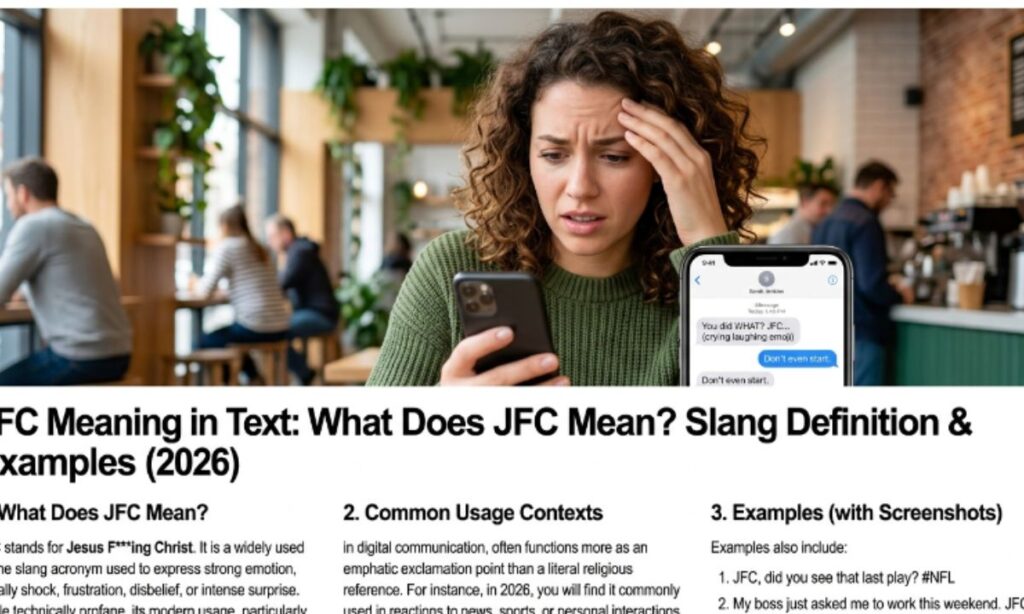
Scrolling through a group chat and someone drops “JFC” out of nowhere? You’re not alone in wondering what it means. This three-letter acronym pops up constantly in texts, tweets, Reddit threads, and TikTok comments usually right when someone is frustrated, shocked, or completely done with a situation.
In this guide, you’ll learn exactly what JFC stands for, where it came from, how people actually use it online, whether it’s considered rude, and when you should (or shouldn’t) type it yourself. We’ve also broken down how it compares to similar acronyms like OMG, WTF, and FFS, so you’ll never second-guess a text again.
What Does JFC Stand For?
JFC most commonly stands for “Jesus F*ing Christ.”** It’s an exclamation used to express shock, frustration, anger, or disbelief basically the digital version of throwing your hands up in exasperation.
Think of it as a stronger, more intense cousin of “OMG.” While OMG can express surprise about almost anything (good or bad), JFC almost always carries a negative or exasperated tone. People type it when something has gone wrong, when they’re annoyed beyond words, or when a situation is just plain ridiculous.
Here’s the quick breakdown:
| Letter | Stands For |
| J | Jesus |
| F | F***ing |
| C | Christ |
It’s worth noting that JFC is a mild censoring trick spelling out the full profane phrase in text can feel harsher or trigger content filters, so the acronym softens it slightly while keeping the emotional punch intact.
Where Did JFC Come From?
JFC isn’t a brand-new invention of the smartphone era it’s rooted in a much older verbal expression. “Jesus Christ” (and its more emphatic version) has been used as an exclamation of frustration or shock in English-speaking countries for generations, long before texting existed.
The shift to “JFC” happened as internet slang culture exploded in the early 2000s and 2010s. As texting, instant messaging, and early social platforms like AIM, MSN Messenger, and later Twitter took off, users began abbreviating common phrases to save keystrokes and type faster. Just like “OMG” (Oh My God) and “WTF” (What The F***) became shorthand for their spoken equivalents, “JFC” followed the same pattern.
A few key points about its evolution:
- Origin base: A pre-existing profane exclamation used in everyday speech.
- Digital adaptation: Abbreviated for speed and slight censorship in texting and online forums.
- Popularized by: Gaming chats, forums like Reddit, and early social media where fast, emotionally charged reactions were common.
- Mainstreamed by: Twitter/X, TikTok comments, and meme culture, where short, punchy reactions perform well.
Today, JFC is fully embedded in internet slang dictionaries and casual digital communication across generations, though it remains most popular with younger users on social platforms.
How People Use JFC in Texting and Online Chats
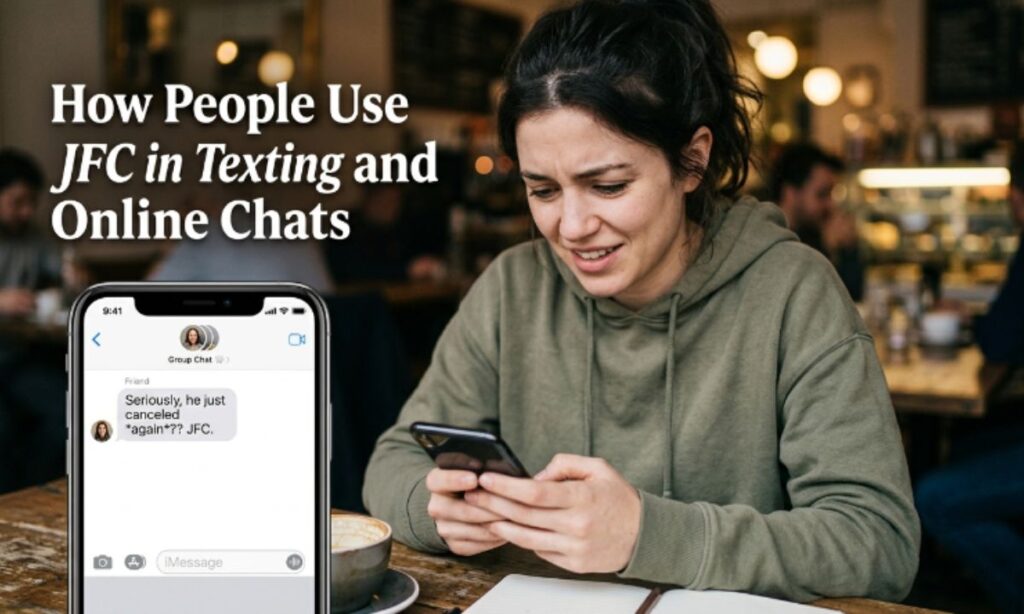
JFC is a flexible, all-purpose reaction. People rarely build entire sentences around it — instead, it’s dropped in as a standalone exclamation or a quick prefix before explaining what’s wrong.
Common usage patterns include:
- As a standalone reaction: “JFC.” (sent alone, letting the frustration speak for itself)
- As a sentence starter: “JFC, can this day get any worse?”
- Paired with an explanation: “JFC, my flight got cancelled again.”
- In response to bad news: “JFC that’s awful, are you okay?”
- Reacting to something absurd or funny-annoying: “JFC why is my WiFi doing this right now”
It typically shows up in casual, informal contexts: texting close friends, gaming voice/text chats, group chats, Discord servers, and comment sections. It’s rarely used in professional or formal writing because of its profane root.
Tone Matters
The tone of JFC shifts slightly depending on context:
- Frustrated tone: Traffic, tech problems, annoying coworkers.
- Shocked tone: Unexpected news, dramatic plot twists, wild stories.
- Sympathetic tone: Reacting to someone else’s bad situation.
- Sarcastic/humorous tone: Reacting to something absurd in a lighthearted way.
JFC vs. Other Similar Acronyms (OMG, WTF, FFS)
JFC often gets lumped in with other reaction-based acronyms, but each carries a slightly different weight and tone. Here’s how they compare:
| Acronym | Full Meaning | Typical Tone | Intensity Level | Common Use Case |
| JFC | Jesus F***ing Christ | Frustrated, shocked, exasperated | High | Reacting to something bad or ridiculous |
| OMG | Oh My God | Surprised, excited, shocked | Low–Medium | Reacting to good or bad surprises |
| WTF | What The F*** | Confused, shocked, annoyed | High | Reacting to something confusing or outrageous |
| FFS | For F***’s Sake | Annoyed, exasperated | Medium–High | Reacting to repeated annoyance or minor frustration |
Key differences:
- OMG is the most versatile and least intense it works for both happy and upsetting news.
- WTF leans toward confusion mixed with shock, often used when something doesn’t make sense.
- FFS signals mild-to-moderate irritation, often about something repetitive or petty.
- JFC sits at the higher end of intensity, usually reserved for genuinely frustrating, shocking, or overwhelming moments.
In short: if OMG is a raised eyebrow, JFC is closer to a frustrated sigh combined with a facepalm.
Is JFC Offensive or Rude to Say?
This depends heavily on context, audience, and personal or religious beliefs.
Because JFC derives from a phrase many people consider profanity invoking a religious figure alongside an expletive it can be seen as offensive by:
- People who hold strong religious beliefs, particularly practicing Christians.
- Older generations or more formal social circles.
- Workplace, school, or professional environments.
- People who are simply uncomfortable with casual swearing.
On the other hand, many casual internet users see JFC as mild slang rather than a serious curse, especially since it’s abbreviated and not spelled out in full. It’s often treated similarly to saying “geez” or “jeez” used to be treated a softened stand-in for something stronger.
Quick Guide: Offensive or Not?
| Context | Likely Reception |
| Texting close friends | Generally fine |
| Gaming chats / Discord | Very common, mostly fine |
| Social media comments | Common, low risk |
| Family group chats | Depends on family norms |
| Workplace Slack/Teams | Risky, avoid |
| Around religious relatives | Best to avoid |
| Formal writing/emails | Never appropriate |
If you’re unsure how someone will take it, it’s safer to default to a milder acronym like “OMG” or spell out your reaction instead.
Examples of JFC in Real Conversations
Seeing JFC in context makes it much easier to understand how naturally it fits into everyday digital conversation. Here are some realistic examples:
Texting a friend about a bad day:
“JFC, my car broke down AGAIN this morning.”
Reacting to shocking news:
“Wait, they got engaged already?? JFC that was fast.”
Gaming chat frustration:
“JFC I just got sniped from across the map, that’s insane.”
Responding to someone venting:
Friend: “My landlord is raising rent by $400 next month.”
You: “JFC that’s rough, I’m sorry.”
Reacting to an absurd headline:
“JFC did you see this news story? I can’t believe that actually happened.”
Sarcastic use:
“Oh JFC, another Monday meeting that could’ve been an email.”
In nearly every case, JFC is doing emotional heavy lifting conveying frustration, disbelief, or sympathy in just three letters instead of a full sentence.
Read More: Common Mistakes People Make Using JFC
When Is It Okay (or Not Okay) to Use JFC?
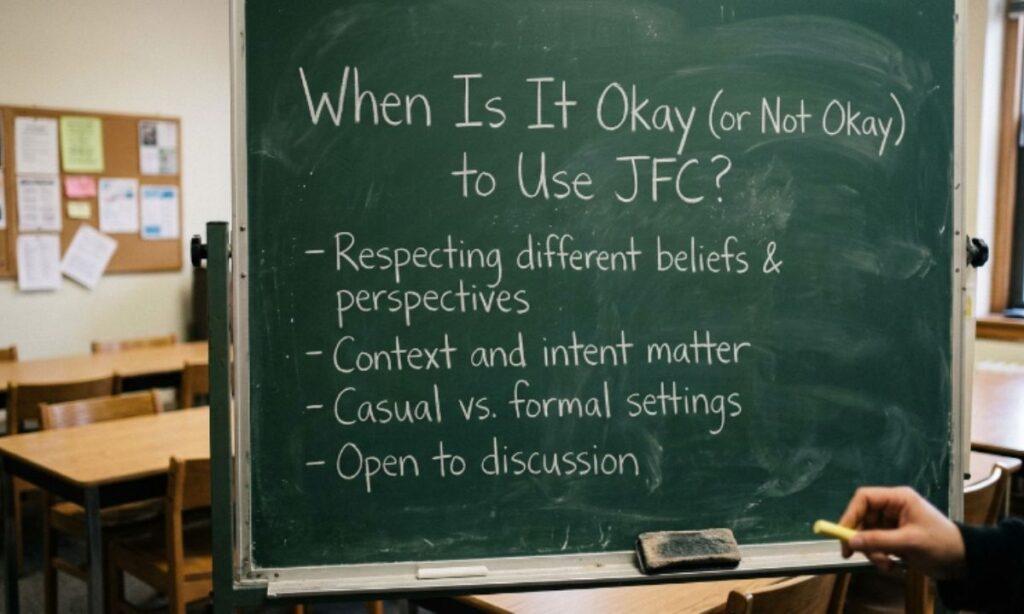
Knowing when to use JFC and when to hold back keeps your texting appropriate for the situation.
✅ Okay to Use JFC When:
- Texting close friends who use similar language.
- Chatting in casual gaming or Discord communities.
- Commenting on relatable, low-stakes social media posts.
- Reacting privately to frustrating personal situations.
- The recipient has used similar slang or profanity before.
❌ Avoid Using JFC When:
- Messaging coworkers, bosses, or clients.
- Talking to religious family members or in religious settings.
- Writing formal emails, resumes, or professional documents.
- You don’t know the other person’s comfort level with mild profanity.
- Posting on public platforms tied to your professional identity (e.g., LinkedIn).
A simple rule of thumb: if you wouldn’t say the full phrase out loud in that setting, skip the abbreviation too.
JFC on Social Media: Twitter, TikTok, and Reddit
JFC thrives across social platforms, where quick, punchy reactions perform well and character limits (or attention spans) favor short slang.
- Twitter/X: JFC is extremely common in reply threads reacting to news, viral videos, or ridiculous screenshots. It often appears at the start of a tweet as an instant emotional reaction before commentary follows.
- TikTok: Shows up frequently in comment sections reacting to shocking, cringeworthy, or dramatic videos. It’s also used in captions for storytime videos describing frustrating personal experiences.
- Reddit: Very common in comment threads, especially in subreddits centered on relationship drama, workplace stories, news, or “Am I the A**hole”-style content, where users react to outrageous situations shared by original posters.
Across all three platforms, JFC generally signals genuine reaction rather than performative outrage it reads as authentic, in-the-moment frustration or disbelief, which is part of why it resonates so strongly online.
Other Meanings of JFC You Should Know
While “Jesus F***ing Christ” is the dominant meaning in texting and casual chat, JFC has several unrelated meanings in other contexts. Knowing these helps avoid confusion if you see JFC used outside a casual conversation.
| Context | Meaning |
| Texting/Internet Slang | Jesus F***ing Christ |
| U.S. Military | Joint Force Commander |
| Business/Legal Documents | Joint Finance Committee (varies by contract) |
| Programming | Java Foundation Classes |
| Business Names | Various companies use “JFC” as an acronym or brand initials |
Important: Context is everything. If you see “JFC” in a military document, a legal contract, or a tech manual, it almost certainly has nothing to do with the slang expression it’s referring to a formal title, committee, or software framework instead.
How to Respond When Someone Texts You JFC
When someone sends you a simple “JFC” often alone, without explanation it usually means they’re overwhelmed, venting, or reacting to something in real time. How you respond depends on the situation.
Here are a few solid response strategies:
- Ask what happened: “JFC why, what’s going on?”
- Show sympathy if they seem upset: “Oh no, are you okay?”
- Match their energy if it’s lighthearted: “Lol same, today has been a lot.”
- Offer support without pushing: “Here if you want to vent.”
- React to shared content: If it’s paired with a link, screenshot, or story, simply react to that content directly.
Avoid responding with “why are you swearing” or overly formal replies since JFC is casual slang, matching that same relaxed tone usually keeps the conversation flowing naturally.
Common Mistakes People Make Using JFC
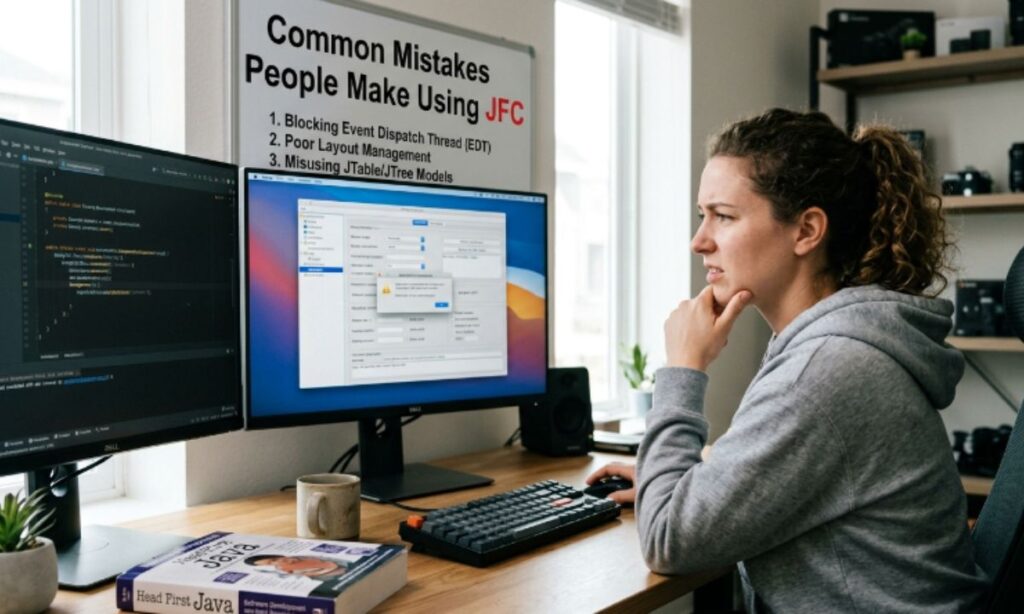
Even simple slang can trip people up. Here are frequent mistakes to watch for:
- Using it in professional settings: Sending JFC in a work Slack channel can come across as unprofessional or inappropriate, even if unintentional.
- Assuming everyone knows the meaning: Not everyone is familiar with internet acronyms older relatives or less online friends may be confused.
- Ignoring religious sensitivity: Using JFC around people who take religious language seriously can unintentionally offend, even if that wasn’t the intent.
- Overusing it: Like any slang, using JFC in every other message dilutes its impact and can come across as excessive or performative.
- Confusing it with other JFC meanings: Mixing up the slang term with military, legal, or tech acronyms in the wrong context can cause genuine misunderstanding.
Being mindful of audience and context solves most of these issues instantly.
Final Thoughts: Should You Use JFC in Your Texts?
JFC is a widely understood, high-intensity internet acronym that expresses frustration, shock, or disbelief in just three letters. It works well in casual texting, gaming chats, and social media places where quick, authentic reactions are the norm.
That said, its profane origin means it’s not universally appropriate. Save it for casual conversations with people who share similar communication styles, and steer clear of using it in professional, formal, or religiously sensitive contexts.
Used thoughtfully, JFC is a handy, expressive shorthand one more tool in the ever-growing vocabulary of digital communication.
Frequently Asked Questions
What does JFC mean in a text message?
JFC typically stands for “Jesus F***ing Christ,” used to express shock, frustration, or disbelief in casual texting.
Is JFC a swear word?
JFC is a censored abbreviation of a profane phrase, so it’s considered mild swearing rather than an outright curse word.
Is it rude to send JFC to someone?
It depends on the person and context — it’s generally fine among close friends but can be seen as rude or inappropriate in formal or religious settings.
What’s the difference between JFC and WTF?
JFC usually expresses frustration or shock, while WTF leans more toward confusion or disbelief about something unexpected.
Can JFC mean something other than the slang term?
Yes, JFC can also stand for “Joint Force Commander” in military contexts or “Java Foundation Classes” in programming.
Is JFC appropriate to use at work?
No, it’s best avoided in workplace communication since it’s rooted in casual profanity and could be seen as unprofessional.
Leave a Reply