The Future Perfect Tense: 100 Example Sentences, Structure & Formula
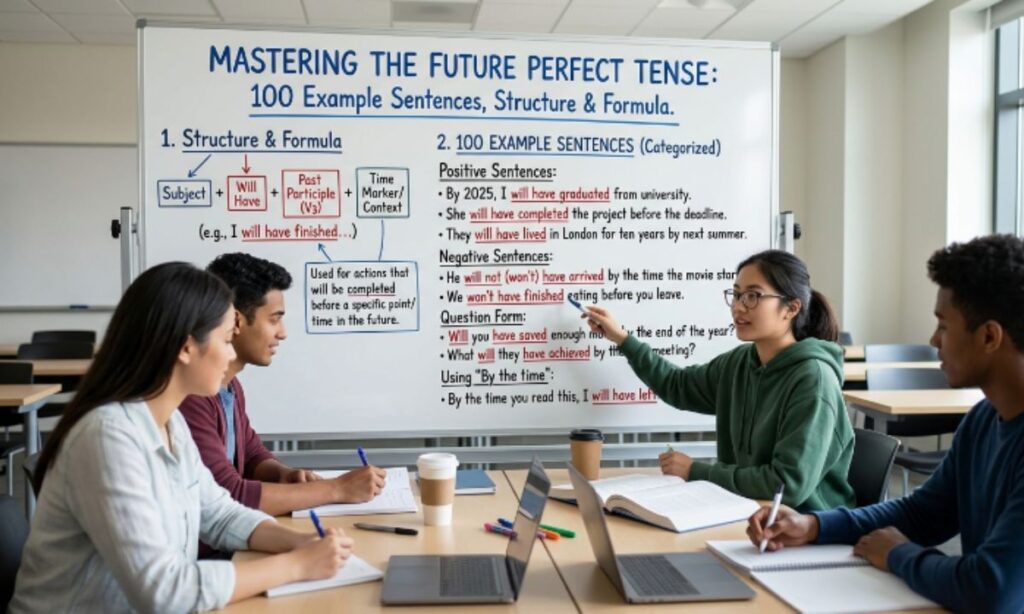
Learning the future perfect tense confuses even advanced English learners because it blends two time frames — the future and the past — into one grammatical structure. This guide breaks down everything you need: the formula, structure, rules, usage, and 100 example sentences you can start using immediately.
What is the Future Perfect Tense?
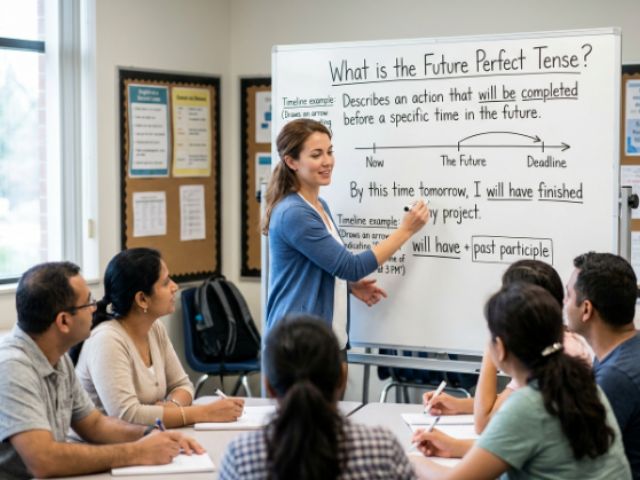
The future perfect tense describes an action that will be completed before a specific point in the future. It connects a future deadline with an action that finishes ahead of it.
For example: By the time you arrive, I will have cooked dinner. Here, the cooking finishes before your arrival — a future event acting as the deadline.
In simple terms, this tense answers the question: “What will already be done by then?”
What is the Formula of the Future Perfect Tense?
The core formula never changes, no matter which subject you use:
Subject + will + have + past participle (V3) + rest of the sentence
Example: She will have finished the project by Friday.
You can also use “shall” instead of “will” with “I” and “we” in formal British English, though “will” is now standard in everyday use.
What is the Structure of the Future Perfect Tense?
The structure shifts slightly depending on whether the sentence is affirmative, negative, or a question. Here’s a quick-reference table:
| Sentence Type | Structure | Example |
| Affirmative | Subject + will have + V3 | They will have left by 9 AM. |
| Negative | Subject + will not have + V3 | They will not have left by 9 AM. |
| Interrogative | Will + subject + have + V3? | Will they have left by 9 AM? |
| Negative Interrogative | Will + subject + not have + V3? | Will they not have left by 9 AM? |
| Passive Voice | Subject + will have been + V3 | The report will have been submitted. |
The Future Perfect Tense Rules
- Always pair “will” with “have” — never drop one or the other.
- The main verb must be in its past participle (third form), never the base form.
- Use a specific future time marker (by, before, by the time) to anchor the action.
- Contractions are common in speech: “will have” becomes “will’ve,” and “will not have” becomes “won’t have.”
- Don’t confuse this tense with the simple future — future perfect emphasizes completion, not just occurrence.
When to Use the Future Perfect Tense?

Use the future perfect tense in these situations:
- To show completion before a deadline : I will have submitted the assignment by midnight.
- To describe an action finished before another future action : She will have left before he arrives.
- To talk about duration up to a future point : By next year, they will have lived here for a decade.
- In predictions about accomplishments : By 2030, scientists will have discovered a cure.
- In formal or academic writing, especially when discussing projected outcomes or timelines.
Time Expressions or Nuances for Future Perfect Tense
Certain time markers naturally pair with this tense because they signal a fixed future deadline:
- By (by noon, by next week, by 2027)
- Before (before you know it, before the meeting)
- By the time (by the time she calls)
- Until/By then
- In (in two years, in a month)
These expressions are key for featured snippet optimization since search engines often pull direct sentence patterns using these words.
The Auxiliary Verbs in Future Perfect Tense
The tense relies on two auxiliary (helping) verbs working together:
- Will — signals the future
- Have — signals the perfect aspect (completion)
Together, “will have” is non-negotiable; both must appear before the past participle. In the passive voice, a third auxiliary, “been,” joins the structure: will have been + V3.
Past Participle Form of Verbs in Future Perfect Tense
The past participle (V3) is the backbone of this tense.
- Regular verbs: add “-ed” (walk → walked, finish → finished, play → played)
- Irregular verbs: follow unique patterns (go → gone, write → written, eat → eaten, see → seen)
A common mistake is using the simple past instead of the past participle — for instance, saying “will have went” instead of the correct “will have gone.”
What are Future Perfect Tense Negative Example Sentences?
Negative sentences insert “not” between “will” and “have.”
- I will not have completed the report by Monday.
- She will not have arrived before the show starts.
- They will not have finished packing by noon.
- We will not have saved enough money by December.
- He will not have read the entire book by tomorrow.
- You will not have graduated by next spring.
- The team will not have won the tournament by then.
- It will not have rained by evening.
- My parents will not have reached home before dark.
- The store will not have closed by 9 PM.
What Future Perfect Tense Interrogative Example Sentences?

Interrogative sentences move “will” before the subject.
- Will you have finished dinner by 8 PM?
- Will she have completed her degree by June?
- Will they have left the office before we call?
- Will he have repaired the car by tomorrow?
- Will we have saved enough for the trip?
- Will the plane have landed by midnight?
- Will the workers have built the bridge by next year?
- Will your sister have moved out by then?
- Will the students have submitted their essays?
- Won’t they have arrived by now?
What are the Examples of the Future Perfect Tense?
Below are 100 future perfect tense example sentences, organized by category for easy reference.
Affirmative Examples (1–40)
- I will have finished my homework by 6 PM.
- She will have cooked dinner before you arrive.
- They will have moved into their new house by March.
- He will have completed the marathon by noon.
- We will have painted the entire fence by Sunday.
- You will have learned French by the end of the year.
- The company will have launched its new product by fall.
- My brother will have graduated by next June.
- The train will have departed before we reach the station.
- The children will have gone to bed by 9 PM.
- I will have saved five thousand dollars by December.
- She will have written three novels by the age of thirty.
- They will have built the new stadium by 2027.
- He will have repaired the roof before the storm hits.
- We will have cleaned the entire house by evening.
- You will have mastered this skill within a month.
- The doctor will have examined all patients by lunchtime.
- The bakery will have sold out of bread by 10 AM.
- My grandparents will have celebrated fifty years of marriage by next week.
- The team will have practiced for six hours by sunset.
- I will have read the whole book by tomorrow.
- She will have signed the contract before the deadline.
- They will have planted all the trees by spring.
- He will have paid off his loan by next year.
- We will have traveled to five countries by 2030.
- You will have finished the course by August.
- The chef will have prepared the banquet by 7 PM.
- The workers will have completed the bridge by winter.
- My aunt will have retired by the time I turn thirty.
- The players will have scored three goals by halftime.
- I will have packed all my bags by midnight.
- She will have submitted her thesis by Friday.
- They will have renovated the kitchen by next month.
- He will have memorized the entire speech by tomorrow.
- We will have watched the whole series by the weekend.
- You will have completed your training by June.
- The scientists will have finished the experiment by noon.
- The airline will have upgraded its fleet by 2028.
- My friend will have opened her own bakery by next year.
- The city will have installed new streetlights by December.
Negative Examples (41–65)
- I will not have finished the report by tomorrow.
- She will not have left the office before six.
- They will not have completed the audit by Friday.
- He will not have paid the bill by the due date.
- We will not have arrived before the ceremony begins.
- You will not have studied enough by exam day.
- The manager will not have approved the budget by Monday.
- The plane will not have landed by 5 PM.
- My cousin will not have finished college by next year.
- The store will not have restocked the shelves by morning.
- I will not have replied to all the emails by noon.
- She will not have cooked the meal by the time guests arrive.
- They will not have signed the agreement by tonight.
- He will not have repaired the laptop by tomorrow.
- We will not have decorated the hall by evening.
- You will not have submitted the form by the deadline.
- The team will not have finished the project by Thursday.
- The bus will not have reached downtown by rush hour.
- My father will not have retired by sixty.
- The workers will not have painted the building by winter.
- I will not have written the essay by midnight.
- She will not have called back by tomorrow morning.
- They will not have built the fence before autumn.
- He will not have completed the marathon by two hours.
- We will not have packed everything by departure time.
Interrogative Examples (66–85)
- Will you have finished the assignment by tonight?
- Will she have arrived before the movie starts?
- Will they have completed the renovation by spring?
- Will he have paid the rent by the first of the month?
- Will we have saved enough for the vacation?
- Will the doctor have reviewed the results by Monday?
- Will the students have submitted their projects by Friday?
- Will the plane have taken off by 10 AM?
- Will your parents have reached home by dinner?
- Will the team have practiced enough by game day?
- Will you have graduated by next summer?
- Will she have cooked the entire meal by 7 PM?
- Will they have moved out before the lease ends?
- Will he have fixed the car by tomorrow?
- Will we have finished the meeting by noon?
- Won’t you have completed the course by then?
- Won’t she have called by now?
- Won’t they have arrived before the storm hits?
- Won’t he have submitted the paperwork by Friday?
- Won’t we have cleaned the house by evening?
Passive Voice Examples (86–100)
- The bridge will have been completed by next winter.
- The report will have been submitted by Friday.
- The house will have been painted by the time we return.
- The contract will have been signed by tomorrow.
- The package will have been delivered by noon.
- The building will have been demolished by next year.
- The email will have been sent before the meeting starts.
- The songs will have been recorded by next week.
- The car will have been repaired by evening.
- The documents will have been reviewed by Monday.
- The stadium will have been built by 2028.
- The invoice will have been paid before the deadline.
- The garden will have been planted by spring.
- The award will have been presented before the ceremony ends.
- The results will have been announced by midnight.
Frequently Asked Questions
What is an easy way to remember the future perfect formula?
Just remember three words: “will have + V3.” If your sentence has all three in that order, it’s future perfect.
How is future perfect different from simple future?
Simple future shows an action will happen (“I will finish”), while future perfect shows it will be done by a specific time (“I will have finished by 6 PM”).
Can future perfect be used in passive voice?
Yes. The passive structure is will have been + past participle, as in “The work will have been completed by Friday.”
Is “shall have” still used today?
Rarely. “Shall have” appears mostly in formal British or legal writing; “will have” is standard in modern English.
What are common mistakes with this tense?
The biggest errors are dropping “have” or using the simple past instead of the past participle, such as saying “will have went” instead of “will have gone.”
Can future perfect be used without a time expression?
Technically yes, but it’s rare and can sound incomplete. Time markers like “by,” “before,” or “by the time” give the sentence its meaning and are almost always included.
Conclusion
The future perfect tense might look intimidating at first, but once you internalize the formula — subject + will have + past participle — it becomes second nature. Whether you’re describing a deadline, a completed project, or an event that finishes before another future action, this tense gives your English precision and clarity. Practice with the 100 examples above, pay attention to time expressions like “by” and “before,” and you’ll be using the future perfect tense confidently in both writing and conversation.
Leave a Reply