Articles Worksheet for Class 2 in English Grammar | Pack of 3 Best Grammar Exercises
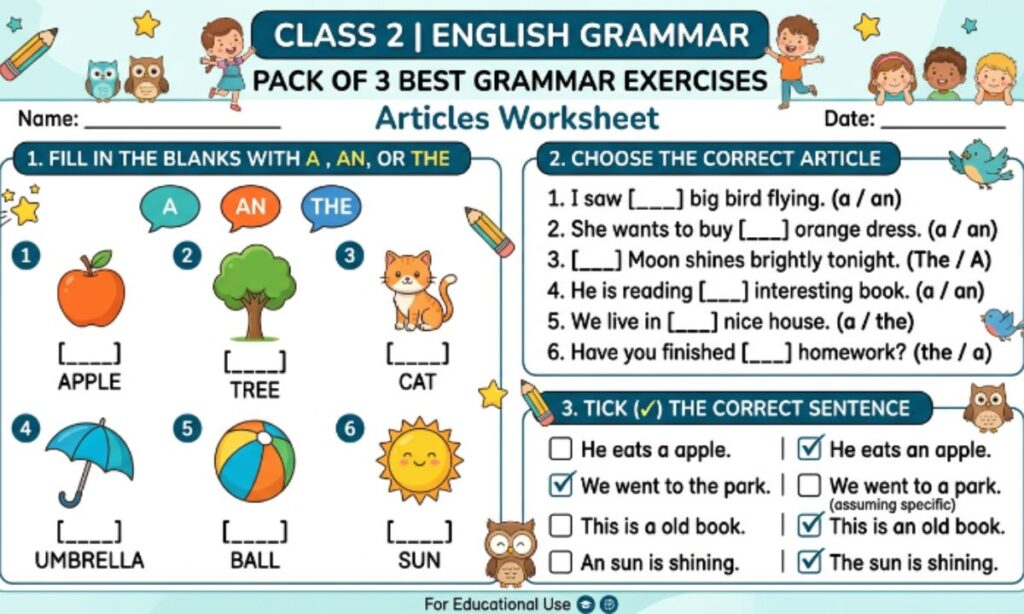
Learning grammar doesn’t have to feel like a chore, especially not for a seven-year-old holding a pencil for the very first “real” grammar lesson. Articles — those tiny but mighty words a, an, and the — are usually the first grammar topic that Class 2 students meet after nouns. This articles worksheet for Class 2 in English grammar is built as a pack of three simple, engaging exercises that help young learners understand exactly when and why we use these three small words.
Whether your child studies under CBSE, ICSE, or any state board, this guide walks you through why articles matter, what skills your child will gain, and how to use the worksheet at home or in the classroom.
Why Should Children of Class 2 Learn This Topic?
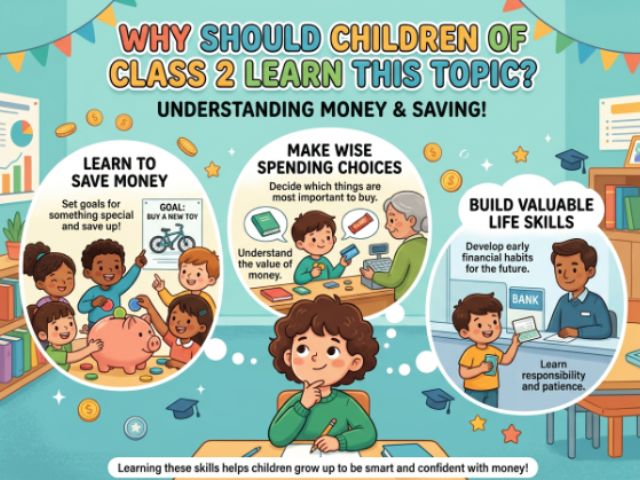
Articles are among the most frequently used words in the English language, yet many young learners skip over them without realizing their importance. Here’s why Class 2 is the right time to introduce this topic:
- Articles appear in almost every sentence. Children read and write “a,” “an,” and “the” dozens of times a day, so mastering them early builds confident readers and writers.
- They strengthen the Parts of Speech foundation. Once kids understand articles, moving on to nouns, pronouns, and adjectives becomes much easier.
- They improve sentence accuracy. A child who knows the difference between “a ball” and “an apple” will naturally write clearer, more correct sentences.
- They prepare kids for exams. Articles are a common topic in Class 2 English grammar tests, including schools that follow the articles worksheet for class 2 in English grammar ICSE pattern.
- They build listening and speaking skills. Correct article usage helps children speak fluently and sound natural in conversation.
Introducing articles at this stage gives children a grammar habit that sticks for life — long before the rules start feeling complicated.
What Are the Learning Outcomes?
By the end of this worksheet pack, a Class 2 student should be able to:
- Identify the three articles — a, an, and the — in a sentence.
- Understand the difference between indefinite articles (a, an) and the definite article (the).
- Choose “a” before consonant sounds and “an” before vowel sounds correctly.
- Use “the” for specific, particular, or one-of-a-kind nouns.
- Apply article rules confidently while filling blanks, circling answers, or completing sentences.
- Build a stronger base for advanced grammar topics like adjectives and determiners in higher classes.
| Learning Outcome | Skill Developed |
| Recognizing articles in sentences | Reading comprehension |
| Choosing a vs an | Phonetic awareness (sound recognition) |
| Using “the” correctly | Understanding specificity in language |
| Completing worksheet exercises | Writing accuracy and grammar application |
| Practicing with answers | Self-correction and confidence building |
Articles Worksheet for Class 2 in English Grammar ICSE
ICSE schools generally expect a slightly more structured approach to grammar than other boards, with an emphasis on rule-based learning and written practice. This worksheet pack aligns well with that expectation because it:
- Introduces the rule before the exercise, so children understand the “why” behind each answer.
- Uses simple, age-appropriate vocabulary that matches the ICSE Class 2 syllabus.
- Includes exercises that mirror common ICSE class tests and homework formats.
- Encourages independent thinking through fill-in-the-blank and circling activities rather than rote memorization.
Even if your child isn’t enrolled in an ICSE school, this structure works equally well for CBSE, state board, and homeschooling curriculums, since the core article rules remain the same across boards.
Articles a, an, the Worksheet With Answers
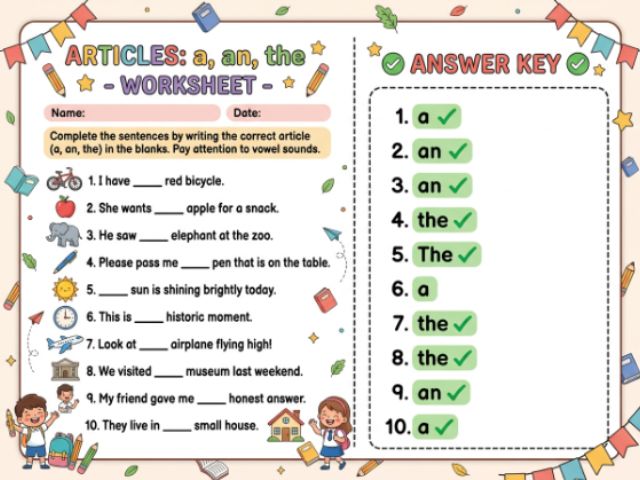
One of the biggest advantages of this worksheet pack is that it comes with answers. This matters for two reasons:
- Parents can check work instantly without needing to be grammar experts themselves.
- Children can self-correct, which builds independence and reduces reliance on constant supervision.
Quick Rule Recap Before You Begin
| Article | Type | When to Use | Examples |
| A | Indefinite | Before words starting with a consonant sound | a dog, a ball, a school |
| An | Indefinite | Before words starting with a vowel sound (a, e, i, o, u) | an apple, an elephant, an hour |
| The | Definite | Before specific, unique, or already-known nouns | the sun, the moon, the teacher |
A helpful tip for kids: the rule is based on sound, not just the spelling of the first letter. That’s why we say “an hour” (the “h” is silent) but “a university” (it sounds like “yoo”).
Read More: Simple Present Tense Worksheet: Free Practice Exercises With Answers
What Does This Worksheet Offer?
This pack of three worksheets is designed to build skills in layers — starting simple and gradually increasing in challenge.
1. Fill in the Blanks Worksheet
Children complete short, everyday sentences by writing the correct article in the blank space.
- Example: I saw ___ elephant at the zoo.
- Builds basic recall of the a/an/the rule.
2. Circle the Correct Article Worksheet
Two or three article options are given in brackets, and the child circles or underlines the correct one.
- Example: She has (a / an) umbrella.
- Strengthens recognition and comparison skills.
3. Sentence Completion Worksheet
Children complete partial sentences using the right article, often with picture support for visual learners.
- Example: ___ sun rises in the east.
- Encourages independent sentence construction.
Together, these three exercises cover recognition, application, and independent usage — the three stages every child needs to truly master a grammar concept.
Articles Worksheet for Class 2 (Practice Section)
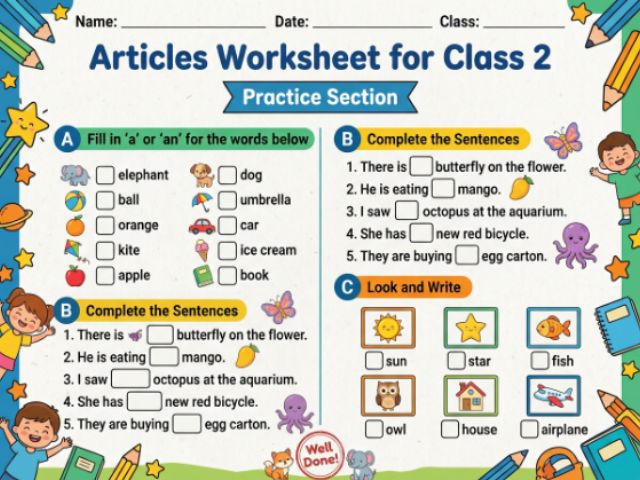
Here are a few sample questions your child can try right now, based on the same pattern used in the worksheet pack.
Exercise A: Fill in the blanks with “a” or “an.”
- I have ___ pencil in my bag.
- She ate ___ orange for breakfast.
- He is ___ honest boy.
- We saw ___ owl in the tree.
- My mother bought ___ umbrella.
Exercise B: Circle the correct article.
- (A / An) cat is sleeping on the mat.
- I need (a / an) hour to finish this.
- That is (a / an) useful book.
Exercise C: Fill in the blanks with “a,” “an,” or “the.”
- ___ moon shines at night.
- I want to buy ___ new bicycle.
- ___ teacher praised the students.
Answer Key
| Question | Answer |
| Exercise A – Q1 | a |
| Exercise A – Q2 | an |
| Exercise A – Q3 | an |
| Exercise A – Q4 | an |
| Exercise A – Q5 | an |
| Exercise B – Q1 | A |
| Exercise B – Q2 | an |
| Exercise B – Q3 | a |
| Exercise C – Q1 | The |
| Exercise C – Q2 | a |
| Exercise C – Q3 | The |
Tips for Parents and Teachers
- Read each sentence aloud with your child before choosing the article — hearing the sound helps more than reading the letter.
- Use real objects around the house (“a spoon,” “an apple,” “the fridge”) to reinforce the rule playfully.
- Avoid correcting every mistake immediately; let your child attempt the whole worksheet first, then review using the answer key.
- Turn revision into a quick oral game by asking, “a or an?” for random words during car rides or mealtime.
- Repeat the worksheet pack after a week to check retention — spaced repetition works far better than one-time practice.
Frequently Asked Questions
What are articles in English grammar for Class 2?
Articles are small words — a, an, and the — placed before nouns to show whether something is general or specific.
What is the difference between “a” and “an”?
“A” is used before words with a consonant sound, while “an” is used before words with a vowel sound.
When do we use “the” in a sentence?
“The” is used when talking about something specific, unique, or already known, like “the sun” or “the teacher.”
Can articles be used with plural nouns?
“A” and “an” are used only with singular nouns, but “the” can be used with both singular and plural nouns.
Are articles used before names of people?
No, articles are generally not used before proper names, so we say “Ravi is happy,” not “a Ravi is happy.”
Why is this worksheet good for Class 2 students?
It offers simple, structured practice with three exercise types and an answer key, making self-learning easy and effective.
Conclusion
Mastering articles is a small step that leads to a big improvement in a child’s overall grammar and writing confidence. This pack of 3 articles worksheets for Class 2 gives young learners exactly what they need: clear rules, varied practice, and instant answers to check their progress. With just a little daily practice, your child will move from hesitating over “a” and “an” to using articles naturally and correctly in everyday sentences — a small grammar win that builds a strong foundation for years of English learning ahead.
Leave a Reply