Next of Kin Meaning: Definition, Examples, Legal Rights & Who Qualifies

If you’ve ever filled out a hospital intake form, applied for a passport, or helped settle a family member’s estate, you’ve probably run into the phrase “next of kin.” It sounds simple, but the meaning behind it is more layered than most people realize — and misunderstanding it can lead to real legal and emotional headaches during already difficult moments.
This guide breaks down exactly what “next of kin” means, who qualifies, what rights it does (and doesn’t) come with, and how it plays out in real situations like medical emergencies, inheritance, and estate administration.
What Does “Next of Kin” Actually Mean?
At its core, next of kin refers to a person’s closest living relative — someone connected to them by blood, marriage, or legal adoption. It’s a term used across medical, legal, and administrative settings to identify who should be contacted, consulted, or given priority when a person can’t speak for themselves or has passed away.
In everyday conversation, people use “next of kin” casually — often listing a close friend, romantic partner, or roommate as an emergency contact. But in a legal or medical context, the term carries more weight. It typically follows a defined hierarchy of relationships, starting with a spouse, then children, parents, and siblings, before extending to more distant relatives.
It’s worth noting that next of kin isn’t always about who you feel closest to. It’s about who the law or an institution recognizes as your closest relative by relationship type, regardless of how emotionally close you actually are.
Next of Kin vs. Legal Heir: What’s the Difference?
People often use “next of kin” and “legal heir” interchangeably, but they’re not the same thing.
- Next of kin identifies your closest living relative — this designation matters for medical decisions, notifications, and funeral arrangements.
- Legal heir refers specifically to someone entitled to inherit property under inheritance laws when there’s no valid will.
In many cases, your next of kin and your legal heir are the same person — usually a spouse or child. But the two concepts serve different purposes. Next of kin can apply while you’re alive (for medical decisions), while “heir” only becomes relevant after death and during probate.
| Feature | Next of Kin | Legal Heir |
| Applies when alive? | Yes (medical decisions) | No |
| Applies after death? | Yes (funeral, notification) | Yes (inheritance) |
| Determined by | Relationship hierarchy | State intestate succession laws |
| Can be overridden by a will? | Not directly | Yes, a will can name different beneficiaries |
| Requires legal proof? | Sometimes | Yes, through probate court |
Understanding this distinction matters because having a will can override who inherits your assets — but it usually doesn’t change who is recognized as your next of kin for medical or emergency purposes unless you’ve also set up a healthcare directive or power of attorney.
Who Qualifies as Next of Kin? A Breakdown by Relationship
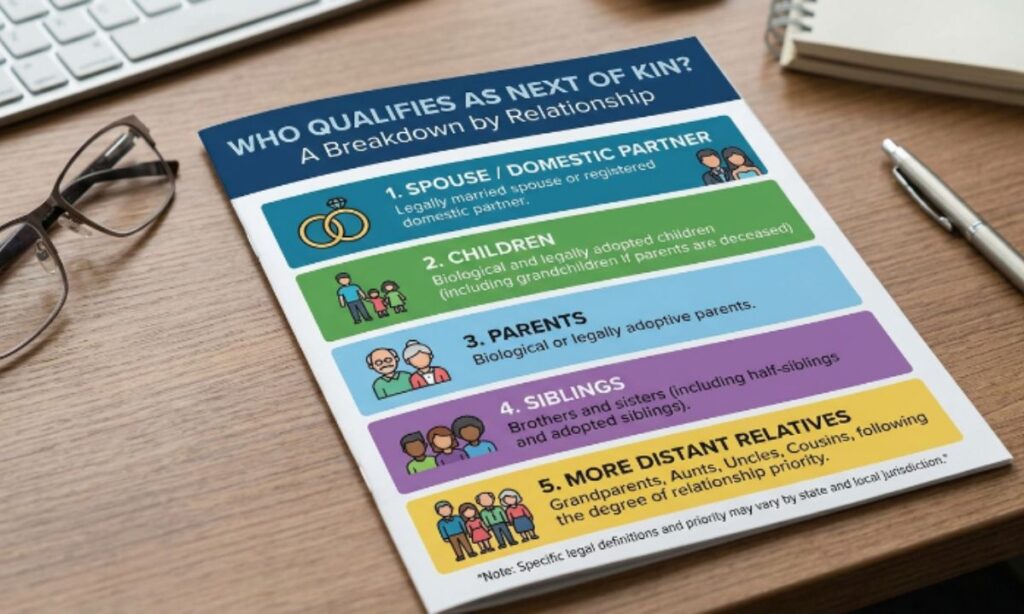
Most states and institutions follow a general order of priority when identifying next of kin. While exact rules vary, the typical hierarchy looks like this:
- Spouse (including legally recognized domestic partners in some states)
- Children (biological and legally adopted)
- Parents
- Siblings
- Grandparents
- Aunts, uncles, nieces, and nephews
- Cousins (in the absence of any closer relatives)
A few important clarifications:
- Adopted children are generally treated the same as biological children under next of kin rules.
- Stepchildren are usually not automatically considered next of kin unless they were legally adopted.
- Unmarried partners typically have no automatic next of kin status, regardless of how long the relationship has lasted.
- Foster children are generally excluded unless a legal adoption took place.
If multiple people share the same level of relationship — for example, several adult children — they’re usually treated as equally ranked next of kin, with decisions or inheritance shared or requiring agreement among them.
Does Next of Kin Have a Legal Definition, or Does It Vary by State?
This is where things get genuinely confusing, and it depends heavily on where you live.
In the United States, most states do have some form of legal recognition for next of kin, primarily through intestate succession laws (the rules that apply when someone dies without a will). However, the exact order of priority, and who counts as a qualifying relative, can differ from state to state.
In the United Kingdom, by contrast, “next of kin” has no formal legal definition in most contexts. It’s a term commonly used by hospitals and institutions, but it doesn’t automatically grant legal decision-making authority the way people often assume.
Because of this variation, it’s smart to check your specific state’s probate code or consult a local estate attorney if you need clarity on how next of kin is defined where you live.
Real-Life Examples of Next of Kin in Action
Understanding the concept in the abstract only goes so far. Here’s how it plays out in everyday situations:
- Medical emergency: A man is in a serious car accident and unconscious. He has no healthcare directive. The hospital contacts his wife as his next of kin to make treatment decisions.
- Death without a will: A woman dies without a will, leaving behind two adult children and no spouse. Her children are recognized as her next of kin and inherit her estate under intestate succession laws.
- Notification after death: Police identify a deceased individual and must notify their next of kin — typically starting with a spouse or parent — before releasing details publicly.
- Unmarried partner denied authority: A woman wants her long-term partner to make medical decisions for her, but they never married or created a healthcare directive. When she’s hospitalized and unable to communicate, doctors turn to her parents instead, since partners generally aren’t automatic next of kin.
These examples show why next of kin status matters well beyond paperwork — it directly shapes who has a voice in some of life’s most critical moments.
What Rights Does Next of Kin Actually Give You?
Being someone’s next of kin can come with meaningful rights and responsibilities, though these vary by state and situation. Common rights include:
- Access to information : the right to receive updates about a hospitalized or incapacitated relative’s condition
- Medical input : the ability to participate in treatment decisions when no healthcare directive exists
- Funeral and burial authority : the right to make decisions about disposition of remains
- Estate involvement : potential rights to inherit or administer an estate when there’s no will
- Notification rights : being formally informed in cases of death, hospitalization, or emergency
However, next of kin status does not automatically grant legal authority to manage someone’s finances, override their documented wishes, or act as executor of their estate unless formally appointed by a court or named in legal paperwork.
Next of Kin in Medical Decisions: What You Can and Can’t Do
Hospitals frequently rely on next of kin when a patient can’t communicate and hasn’t designated a healthcare agent. But the actual authority granted to next of kin is often more limited than people assume.
What next of kin can typically do:
- Receive updates on the patient’s condition
- Be consulted on general treatment decisions
- Consent to certain procedures in an emergency, depending on state law
What next of kin usually cannot do:
- Override a valid healthcare directive or living will
- Make decisions if a designated healthcare power of attorney exists and is available
- Access full medical records without proper authorization in every circumstance
This is a critical distinction: next of kin is often a default decision-maker, not a guaranteed one. If you want a specific person — such as an unmarried partner or close friend — to make medical decisions on your behalf, you need a healthcare power of attorney or advance directive naming them directly.
Next of Kin and Inheritance: Do They Automatically Get Assets?

Not necessarily — and this is one of the most misunderstood aspects of the term.
If someone dies with a valid will, their assets go to the beneficiaries named in that will, regardless of next of kin status. A next of kin has no automatic claim if they weren’t included, unless they successfully contest the will.
If someone dies without a will (intestate), then next of kin becomes central. State intestate succession laws determine who inherits, typically following this general order:
- Surviving spouse
- Children
- Parents
- Siblings
- More distant relatives, if no closer next of kin exists
It’s also worth noting that certain assets — like life insurance policies, retirement accounts, and payable-on-death bank accounts — pass directly to named beneficiaries, completely bypassing next of kin rules altogether.
Read More: What Does Adonai Mean? A Simple Definition and Complete Guide
Married Couples, Unmarried Partners, and Next of Kin Status
Marriage generally provides the strongest and most automatic next of kin status. A legally married spouse is almost universally recognized as next of kin for both medical and inheritance purposes.
Unmarried partners, however, occupy a much murkier position:
- In most states, unmarried partners have no automatic next of kin rights, no matter how long they’ve been together.
- Domestic partnerships or civil unions, where legally recognized, may grant some next of kin-equivalent status, but this varies significantly by state.
- Without legal documentation, an unmarried partner could be excluded entirely from medical decisions or inheritance, even in favor of estranged biological relatives.
This is precisely why estate attorneys strongly recommend that unmarried couples create healthcare directives, powers of attorney, and wills — documents that explicitly name the partner and remove any ambiguity.
What Happens When There’s No Clear Next of Kin?
Sometimes a person has no living spouse, children, parents, or siblings — or all potential next of kin are unreachable. In these cases:
- Courts may look further down the family tree to grandparents, aunts, uncles, or cousins.
- If truly no relatives can be located, the estate may escheat — meaning it legally reverts to the state government.
- For medical decisions, hospitals may rely on a court-appointed guardian or an ethics committee if no next of kin can be identified.
- For funeral arrangements, local government or a public administrator may step in to handle final arrangements.
This scenario is relatively rare but underscores why having documented wishes in place — regardless of family structure — provides an important safety net.
How to Legally Designate or Change Your Next of Kin
Here’s the part many people don’t realize: you generally cannot simply “declare” someone as your legal next of kin. It’s determined by relationship status, not personal preference. However, you can take legal steps to ensure the right person has authority over your decisions and assets:
- Create a healthcare power of attorney to name who makes medical decisions if you’re incapacitated
- Draft a living will or advance directive outlining your medical treatment preferences
- Write a valid will to specify exactly who inherits your assets
- Update beneficiary designations on life insurance, retirement accounts, and bank accounts
- Consider a durable power of attorney for financial decision-making authority
- Consult an estate planning attorney if you’re in a non-traditional family structure or want to bypass default next of kin rules
These documents don’t change who is legally recognized as your next of kin, but they do override default next of kin authority in the specific situations they cover.
Common Myths About Next of Kin You Should Stop Believing

- Myth: Next of kin has full legal authority over all decisions.
Reality: Authority is often limited and can be overridden by wills, healthcare directives, or powers of attorney. - Myth: You can list anyone as your next of kin and it’s legally binding.
Reality: Emergency contact forms let you list anyone, but that doesn’t create legal next of kin status. - Myth: Next of kin and beneficiary mean the same thing.
Reality: A beneficiary is named in a will or policy; next of kin is determined by relationship hierarchy and may differ entirely. - Myth: Unmarried partners are automatically treated like spouses.
Reality: In most states, unmarried partners have no automatic next of kin rights without legal documentation. - Myth: Next of kin always inherits everything.
Reality: A valid will can direct assets elsewhere, leaving next of kin with no automatic inheritance.
Conclusion
“Next of kin” might sound like a simple family term, but it carries real legal weight in medical emergencies, estate matters, and end-of-life decisions. Understanding who qualifies — and just as importantly, what rights that status does and doesn’t include — can help you avoid confusion and protect your loved ones’ interests when it matters most.
If your family situation doesn’t fit neatly into the default next of kin hierarchy — whether you’re unmarried, in a blended family, or simply want to ensure specific people have authority — the smartest move is to put your wishes in writing. A will, healthcare directive, and power of attorney can override default assumptions and make sure the right people are empowered to act on your behalf.
Frequently Asked Questions
What does next of kin mean in simple terms?
It means your closest living relative, typically determined by blood, marriage, or legal adoption,
Do stepchildren count as next of kin?
Usually not, unless they were legally adopted by the deceased or incapacitated person.
What happens if there’s no living next of kin?
Courts look to more distant relatives, and if none exist, the estate may revert to the state.
Is next of kin the same as an executor?
No, an executor is formally named in a will and has specific legal authority; next of kin doesn’t automatically hold that role.
Leave a Reply