MSRP Meaning: What Does MSRP Stand For? Definition & How It Works
When you’re shopping for a new car, a high-end TV, or even a major appliance, you will almost certainly encounter a four-letter acronym: MSRP. While it’s a common term, the concept behind it—the Manufacturer’s Suggested Retail Price—is often misunderstood.
You might assume it’s the final price you must pay, or that it represents a non-negotiable number. In reality, it’s a benchmark, a starting point for the negotiation process, and a tool for both manufacturers and consumers. Understanding the MSRP meaning is one of the most powerful tools you can have when making a significant purchase, saving you potentially thousands of dollars .
What Does MSRP Actually Mean?
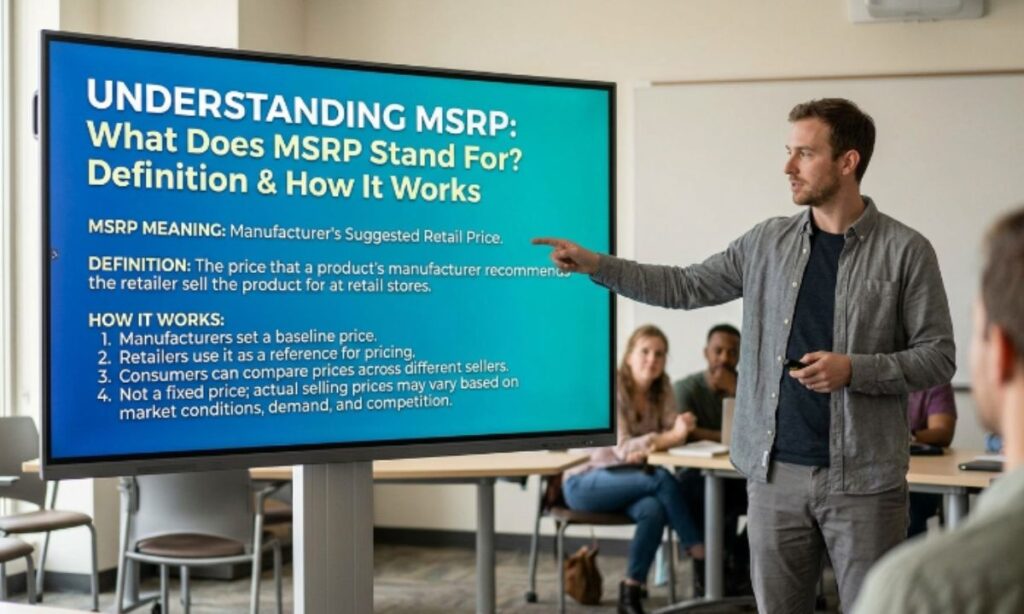
MSRP stands for Manufacturer’s Suggested Retail Price. As the name implies, it is the price that a product’s producer recommends a retailer charge for it at the point of sale. You will also hear it referred to as the “sticker price,” “list price,” or “recommended retail price” (RRP) .
The key word here is “suggested.” It is not a legal requirement or a fixed price. Think of it as a starting point for the pricing conversation. The purpose of the MSRP is to standardize pricing across different retailers, ensuring that a product has a consistent value perception from store to store .
While MSRP can apply to any product, it is most commonly associated with big-ticket items:
- Automobiles: New vehicles are the most prominent use of MSRP.
- Electronics: Televisions, computers, and smartphones often feature an MSRP.
- Appliances: Refrigerators, washing machines, and other major home appliances use this pricing model .
The History Behind Manufacturer’s Suggested Retail Price
The concept of a suggested retail price was developed primarily to help maintain price consistency for goods, particularly as brands began to expand their distribution networks. It provided a standard for retailers, preventing one store from undercutting another and devaluing the product . While the practice started in the late 19th and early 20th centuries, it became formalized and more common in the post-World War II era.
This was when mass-produced consumer goods, particularly automobiles, became a central part of the American economy. The system aimed to level the playing field among dealers and give consumers a fair reference point, ultimately protecting the manufacturer’s brand image .
How MSRP Is Calculated by Manufacturers

The calculation of MSRP is a complex process that involves a wide range of factors. It’s far more than just taking the cost to make a product and adding a profit margin.
Factors Influencing the MSRP
Several key elements contribute to the final figure:
- Production Costs: This includes the cost of raw materials, labor, manufacturing overhead, and factory operations .
- Research & Development: The cost of designing and engineering the product is amortized into its price.
- Marketing & Advertising: The money spent on advertising campaigns, sponsorships, and branding contributes to the MSRP.
- Profit Margin for All Parties: The MSRP is supposed to allow all links in the supply chain—the manufacturer, the distributor, and the retailer—to make a profit. It ensures there is a margin built in for the retailer .
- Market Conditions: A manufacturer will look at a product’s popularity and competitor pricing. A highly anticipated vehicle or a new piece of technology will have a different MSRP than a slower-selling item .
- Regional Variations: Interestingly, MSRP is not a global figure. It often varies by country or region to account for local taxes, import duties, shipping costs, and consumer purchasing power .
MSRP vs. Invoice Price: What’s the Real Difference?
This is arguably the most critical distinction to understand when making a large purchase, particularly a car. The MSRP is the suggested retail price for you, the consumer. The Invoice Price (sometimes called dealer cost) is the price the dealer or retailer pays the manufacturer to buy the product .
The Key Differences
The table below illustrates the core differences between these two vital prices.
| Feature | MSRP (Sticker Price) | Invoice Price (Dealer Cost) |
| Who Sets It | Manufacturer | Manufacturer |
| What It Is | The recommended selling price to the public | The price charged to the dealer/retailer |
| Who Pays It | Consumer | Dealer or Retailer |
| Profit for Dealer | High: Includes dealer profit margin | Low/None: Cost of goods sold |
| Negotiability | The starting point for negotiation | The floor for negotiation |
Key Takeaway: The gap between MSRP and invoice price is the dealer’s potential profit margin. Knowing the invoice price gives you a better idea of how much room you have to negotiate . For example, the MSRP for a base 2023 Toyota Highlander started at $37,955, while its invoice price was around $34,768 . This difference represents roughly $3,000 of negotiating power.
Why Dealers Don’t Always Sell at MSRP
As we’ve established, the “S” in MSRP stands for “Suggested.” A dealer is under no legal obligation to sell a car at that exact price. A retail store can adjust prices based on several factors .
When a Dealer Sells Below MSRP
- Slow Sales: To move inventory off the lot, dealers will often discount cars that are not selling well. This helps free up capital and space for new models .
- Promotions and Clearance: End-of-year clearance events or holiday sales often see prices drop below MSRP .
- Sluggish Economy: In a weak economy, dealers may be forced to lower prices to attract consumers .
When a Dealer Sells Above MSRP
- High Demand: If a vehicle is incredibly popular (like a new sports car or a sought-after hybrid), a dealer may charge an additional “market adjustment” that pushes the price above the MSRP .
- Limited Availability: When supply is constrained, dealers can command higher prices .
MSRP in the Car Buying Process
The MSRP is the anchor of the car-buying experience. It provides a formal, standard price that you can use as a basis for negotiation .
- Your Starting Point: You start your negotiation from the MSRP. You know the dealer has room to move down from this number .
- Your Target: Your goal is to negotiate a price that is as close to the invoice price as possible. This minimizes the dealer’s profit margin and gets you the best deal .
- The Rules: Federal law requires automakers to include the MSRP on the Monroney sticker on the windshield. This price must include the base price of the car, the cost of factory-installed options, and the destination charge .
Expert Tip: When you’re negotiating, use the dealer’s asking price, not the MSRP, as your starting point. The dealer may have already discounted the vehicle. From there, work your way down .
Read More: GTS Meaning in Text: The Ultimate Guide to This Popular Chat Acronym
How MSRP Applies to Electronics and Other Products
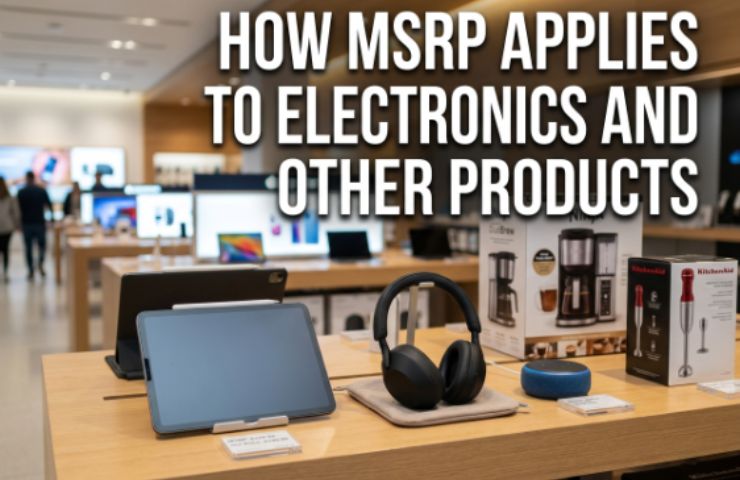
While car buyers are the most familiar with MSRP, it is also a huge factor in the consumer electronics and appliance industries.
In retail, electronics and appliance stores use MSRP in a very specific way. They will show the MSRP alongside their “sale” or “our price” to create a sense of value. This strategy, often called reference pricing, makes the deal seem better .
For instance:
- Product Page: You see a TV listed at $1,000 (MSRP) but it’s “On Sale” for $800.
- Perceived Value: The retailer is not losing money at $800; they are still making a profit. They are using the MSRP to make you feel like you’ve just saved $200.
Is MSRP the Same as Sticker Price?
Yes, in most contexts, the terms MSRP and Sticker Price are interchangeable .
However, “sticker price” can also refer to the final price on the window sticker after options and the destination fee are added, which can be higher than the base MSRP.
- Base MSRP: The price of the car with no additional options.
- Sticker Price: The final recommended price on the window sticker, which includes the base MSRP plus the cost of options and the destination charge .
When You Can (and Can’t) Negotiate Below MSRP
You can almost always negotiate the price of a big-ticket item, but your success varies. You have the most leverage when:
- You’re Buying a Car (and There Isn’t a Shortage): The automotive market is built for negotiation .
- You’re Buying “Old” Inventory: You have more leverage on last year’s model or a product the store has had in stock for a while.
- Demand is Low: If the item is a slow seller, dealers and stores are more willing to deal .
You have little to no power to negotiate when:
- Demand Outstrips Supply: You can’t negotiate down a Ford Bronco or PlayStation when they’re impossible to find.
- Fixed-Price Retailers: Some retailers, like large big-box stores or direct-to-consumer brands, have fixed pricing policies and rarely haggle .
- The Price is Already the Lowest: If the price is already heavily discounted, there is no room left .
MSRP vs. MAP: Understanding the Key Distinctions
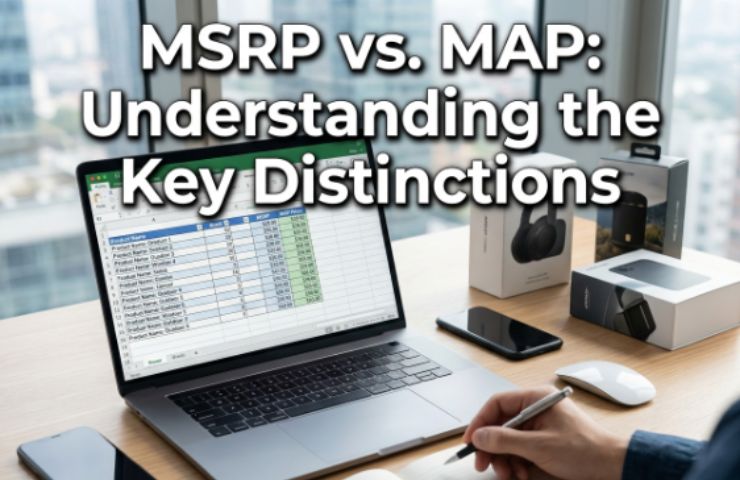
This is a crucial difference for retailers and consumers. While MSRP is a suggestion, MAP (Minimum Advertised Price) is a contractual agreement between a manufacturer and its retailers.
| Feature | MSRP (Manufacturer’s Suggested Retail Price) | MAP (Minimum Advertised Price) |
| Purpose | Suggests a selling price to the customer | Restricts how low a retailer can advertise a product |
| Binding? | No, it is purely a suggestion | Yes, it is a binding contract |
| Consequence | None if violated | Can face penalties, loss of product, or termination of partnership |
| Focus | The final selling price | The advertised price only. A retailer can sell it for less, they just can’t advertise it. |
Why MAP Matters: Imagine a high-end watch brand. They want to maintain a luxury image. If one retailer advertises a $5,000 watch for $3,000, it devalues the entire brand. MAP pricing prevents this.
How to Find the MSRP of Any Product
Finding the MSRP is easier than ever. Here are a few ways to do it.
- Online Manufacturer Website: For cars, you can “build and price” your exact vehicle on the automaker’s site to see the MSRP. For products, the manufacturer’s site is your best source .
- Dealer Websites: For cars, dealer sites list inventory with the MSRP .
- Third-Party Tools: For cars, sites like Edmunds, Kelley Blue Book, and Cars.com have detailed pricing and research tools, providing both MSRP and invoice prices .
- The Window Sticker: On new cars, the Monroney sticker is law. It is displayed on the side window and contains the full MSRP breakdown .
Common Myths About MSRP Pricing
There are a few misconceptions about MSRP that cost consumers money.
- Myth: MSRP is the “Official” Price You Must Pay.
- Reality: MSRP is purely a suggestion .
- Myth: Paying Below MSRP Means the Dealer Lost Money.
- Reality: Dealers often have holdback and incentives from the manufacturer, meaning they can sometimes sell a car for less than invoice and still make a profit .
- Myth: The MSRP is The Best Price.
- Reality: The MSRP is the highest price you should be willing to pay (unless demand is insane). It’s a ceiling, not a floor .
Conclusion
Understanding the MSRP meaning is one of the most important steps you can take to become a savvy shopper. It is not a fixed, non-negotiable number. Instead, the Manufacturer’s Suggested Retail Price is a powerful reference point designed to standardize pricing. By knowing that you can negotiate below MSRP, understanding its relationship to the invoice price, and distinguishing it from MAP, you put yourself in the driver’s seat .
The next time you see a “sticker price” on a car window, a TV, or any high-ticket item, remember: it’s just a suggestion. Do your research, know the market value, and negotiate from a position of knowledge. Your wallet will thank you.
Frequently Asked Questions
What is the full meaning of MSRP?
MSRP stands for Manufacturer’s Suggested Retail Price. It is the price a manufacturer recommends retailers sell a product for .
What is the difference between invoice price and MSRP?
MSRP is the suggested retail price for the consumer, while the invoice price is what the dealer pays the manufacturer for the product .
Is MSRP the final price?
No. MSRP is a starting point for negotiations, not the final price you have to pay. The actual selling price can be above or below the MSRP .
What is the difference between MSRP and MAP?
MSRP is a suggested selling price, whereas MAP (Minimum Advertised Price) is a contractual agreement that sets the lowest price a retailer can legally advertise a product .
How much under MSRP should I pay?
The amount you can negotiate depends on the product, demand, and market value. In a buyer’s market, paying close to the invoice price (which is significantly below MSRP) is a good goal .
Leave a Reply