What Does Adonai Mean? A Simple Definition and Complete Guide
Adonai is one of the most significant names for God in the Hebrew Bible, carrying deep theological and spiritual meaning. In this comprehensive guide, you will learn what Adonai means, its origin, how it compares to other divine names, and why this name continues to shape Jewish and Christian faith today.
What Does Adonai Mean? A Simple Definition
At its most basic level, Adonai (אֲדֹנָי) means “Lord,” “Master,” or “Sovereign One” in Hebrew. It is a name that expresses God’s absolute authority, ownership, and lordship over all creation. Unlike a generic title, Adonai conveys a deeply personal relationship—it’s often translated as “my Lord,” emphasizing both God’s supreme position and a worshiper’s personal devotion .
In Jewish tradition, Adonai serves as the primary spoken substitute for the sacred and unpronounceable name of God, YHWH (the Tetragrammaton), which appears over 6,800 times in the Hebrew Bible . This practice of substitution arose from a profound reverence for God’s holy name, making Adonai one of the most frequently spoken divine names in Jewish prayer and Scripture reading .
No other name applied to God is more definite and more easily understood than Adonai . It clearly identifies God’s role as the one who possesses absolute control and authority over all things. The meaning of this name in Hebrew indicates “mastership” or “ownership,” which defines both God’s ownership of the universe and humanity’s role as servants to their Adonai .
The Origin and Etymology of the Word Adonai

The etymology of Adonai reveals rich layers of meaning and grammatical uniqueness. Adonai is derived from the singular Hebrew word “adon” (אָדוֹן), which means “lord,” “master,” or “owner.” The singular form “adon” appears approximately 215 times in the Old Testament, predominantly translated as “master” when referring to human beings. When used of humans, this term consistently appears in the singular form .
The name Adonai itself is the plural form of “adon” with the addition of the first-person singular possessive pronoun suffix, making it literally mean “my Lords.” This plural form appears approximately 434 times in the Old Testament . The use of the plural has generated significant scholarly discussion, with several interpretations proposed:
- Plural of Majesty (Pluralis Majestatis) : The plural form emphasizes God’s greatness, sovereignty, and fullness of power .
- Plural of Abstract Intensity (Plurale Virtutum) : Hebrew grammarians have identified this as a “plural of strength” that indicates the fullness of divine authority, pointing to God as the “Lord of lords” .
- Plural of Excellence: Some scholars view it as a means of highlighting God’s supreme and unrivaled nature .
The possessive pronoun “my” in Adonai functions similarly to how “Rabbi” means “my master” or “Madonna” means “my lady”—it emphasizes a personal and reverent relationship rather than indicating actual possession. The name encapsulates both distance (in its majesty) and nearness (through the personal suffix).
Adonai in the Hebrew Bible: How Often Is It Used?
Adonai appears approximately 434 times throughout the Old Testament, making it one of the most frequently occurring divine names in Scripture . The first occurrence of Adonai as a divine name appears in Genesis 15:2, where Abraham addresses God: “O Lord God (Adonai Yahweh), what will you give me, for I continue childless?” .
The name’s usage across the Hebrew Bible reflects several patterns:
- Genesis: Appears in key passages where individuals acknowledge God’s sovereignty and authority, including Abraham’s dialogue and other patriarchal narratives
- Exodus: Used in contexts where God’s lordship over Israel and deliverance from Egypt is emphasized
- Psalms: Frequently appears in prayers, hymns, and declarations of praise, often in psalms acknowledging God’s reign over all nations
- Prophets: Used extensively in prophetic literature to emphasize God’s authority and sovereignty over history
The Old Testament distinguishes between the names of God in unique ways. The covenant name YHWH (Yahweh) is used over 6,800 times, with the substitution of Adonai being indicated by the vowel points added to the Tetragrammaton. When the name Adonai appears alongside YHWH, the vowel pointing changes to prevent repetition of “Adonai, Adonai”—a practice known as the Qere perpetuum, where the written text indicates one pronunciation but is read as another .
Adonai vs. Yahweh: Understanding the Difference
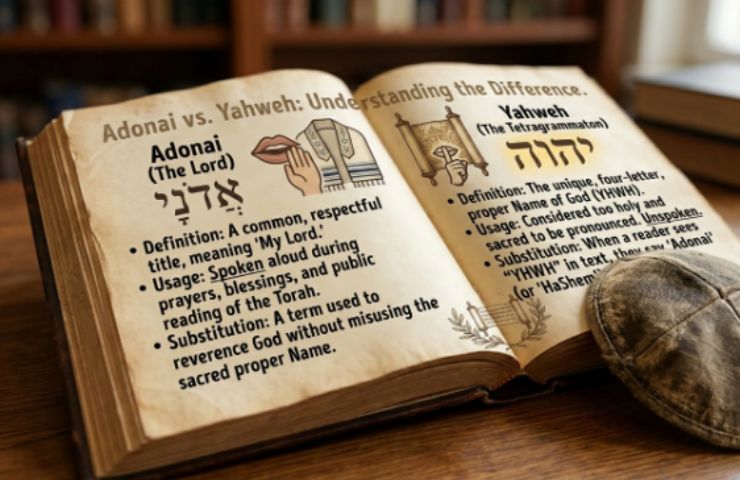
The relationship between Adonai and Yahweh is complex and deeply significant. Here is a comparison table to help clarify the distinctions:
| Feature | Adonai | Yahweh (YHWH) |
| Meaning | “Lord” or “Master” | “I AM THAT I AM” or “He Is” |
| Nature | A title describing God’s role and authority | A personal name revealing God’s essential nature |
| Usage Frequency | ~434 times | ~6,800 times |
| Original Pronunciation | Pronounced as written | No known original pronunciation; replaced in reading |
| Relationship | Used as a spoken substitute for YHWH in tradition | The sacred, ineffable name not to be pronounced |
| Function | Emphasizes sovereignty and lordship | Emphasizes self-existence and covenant faithfulness |
From ancient times, devout Jews refrained from pronouncing the Tetragrammaton—the four consonants YHWH (יהוה)—out of profound reverence for God’s holy name. When reading Scripture aloud, they would substitute the name Adonai in its place. This practice is reflected in the Masoretic Text, where the vowel points of Adonai (a-o-a) were added to the consonants YHWH as a reminder to readers: read “Adonai” instead of attempting the sacred name .
This substitution practice explains why English translations often render YHWH as “LORD” in small capitals. When the name YHWH appeared in the Hebrew text, translators followed the Jewish tradition of substituting “Lord” or “Adonai” rather than attempting to reproduce the original pronunciation .
The hybrid term “Jehovah” emerged in the late Middle Ages when Christian scholars combined the consonants of YHWH with the vowels from Adonai, resulting in a Latinized form that had never actually been spoken historically . Most modern scholars agree that the original pronunciation was likely “Yahweh,” based on how the Hebrew vowel system operates .
Why Jewish Tradition Uses Adonai Instead of God’s Name
The substitution of Adonai for the sacred name of God reflects a deep tradition rooted in reverence and holiness. This practice developed gradually but became firmly established by the time of the Second Temple period and continues in Jewish worship to this day .
Several factors contributed to this tradition:
- Reverence for the Divine Name: The name YHWH was considered too sacred to be pronounced by ordinary people. The commandment “You shall not take the name of the Lord your God in vain” (Exodus 20:7; Deuteronomy 5:11) was interpreted with great strictness, leading to the avoidance of any casual use of the divine name .
- Protection Against Blasphemy: In an era when the punishment for blasphemy included death, avoiding the pronunciation of the sacred name provided a safeguard against misuse .
- Distinction between the Name and the One Named: Jewish tradition maintains a distinction between the “name” of God and God’s essential being. The substitute Adonai conveys God’s relationship to humanity without attempting to name what cannot be fully named.
- Original Synagogue Practice: When scripture is read aloud in the synagogue today, the more generic term Adonai is used in place of YHWH . This practice has been preserved for centuries.
- Further Substitution: Some Orthodox Jews take this practice further, substituting “HaShem” (the Name) in everyday conversation when not engaged in prayer, or using “Adoshem” as a further modification .
This tradition has profoundly influenced translations, resulting in English Bibles distinguishing between LORD (representing YHWH) and Lord (representing Adonai), with the capitalization signaling the underlying Hebrew word .
The Grammatical Structure Behind Adonai (Why It’s Plural)
The grammatical structure of Adonai is unusual and has been the subject of theological reflection and scholarly debate. The plural form “Adonai” has been analyzed by Hebrew grammarians through several lenses:
- Plural of Majesty: The plural form expresses God’s absolute sovereignty and greatness. Much like monarchs using the “royal we,” the plural emphasizes the fullness of God’s authority and power. This is sometimes called the pluralis majestatis—the plural of majesty .
- Plural of Intensity: Hebrew grammar recognizes a category called the plurale virtutum or “plural of strength,” where the plural form amplifies the meaning of the base word. In this case, Adonai indicates not just a lord but “the Lord of lords,” pointing to the supreme and ultimate expression of lordship .
- Plural with Possessive Suffix: The name combines the plural noun with a singular possessive suffix (“my”), creating the sense of “my Lords.” This grammatical construction gives Adonai its distinct character and theological significance.
- Theological Implications of Plurality: Many Christian scholars have seen the plural form as suggestive of the Trinity or plurality within the Godhead, citing parallel constructions like Elohim (another plural form for God). However, traditional Jewish interpretation tends to view this as a grammatical convention rather than a theological statement .
The grammatical uniqueness of Adonai underscores its special status as a name that is simultaneously intimate (using the possessive “my”) and majestic (using the plural form).
Adonai in the Books of Genesis, Exodus, and Psalms

Adonai in Genesis
The name Adonai first appears as a divine name in Genesis 15:2, where Abraham addresses God: “But Abram said, ‘O Lord GOD (Adonai Yahweh), what will you give me, for I continue childless?'” The use of Adonai in the context of God’s promise to Abraham establishes the name as one expressing God’s sovereignty over the unfolding covenant relationship.
Throughout Genesis, Adonai appears at critical moments:
- When Abraham pleads for Sodom (Genesis 18)
- When Abraham expresses faith in God’s provision (Genesis 22)
- When Jacob blesses his sons (Genesis 49)
The use of Adonai in Genesis signals that God’s lordship is not merely theoretical but is demonstrated in specific acts of providence and covenant promise.
Adonai in Exodus
In the book of Exodus, Adonai appears in contexts of deliverance and covenant establishing. One of the most significant passages is Exodus 6:3, where God tells Moses: “I appeared to Abraham, to Isaac, and to Jacob as El Shaddai, but by my name the LORD (YHWH) I did not make myself known to them.” This passage establishes the progressive revelation of God’s name while the substitution of Adonai in reading would have been practiced by later Jewish audiences .
The use of Adonai in Exodus reinforces God’s role as the deliverer who exercises sovereignty over the forces of Egypt and over history itself.
Adonai in Psalms
The Psalms contain some of the most powerful and frequent uses of Adonai, often in contexts of praise and worship. The Psalms employ Adonai to express:
- Royal Sovereignty: “The LORD (Adonai) is king; he is robed in majesty” (Psalm 93)
- Providential Care: “The LORD is my shepherd; I shall not want” (Psalm 23, though using YHWH, reflects the lordship concept)
- Messianic Expectation: “The LORD says to my Lord (Adonai): ‘Sit at my right hand'” (Psalm 110:1)
- Prayer and Petition: “To you, O LORD (Adonai), I call; my rock, do not refuse to hear me” (Psalm 28)
The Psalms demonstrate how Adonai functions as a name that bridges the gap between God’s transcendent majesty and the believer’s personal devotion.
How Adonai Reflects God’s Authority and Lordship
The name Adonai fundamentally communicates God’s absolute sovereignty and rightful rule over all creation. Its meaning encompasses several dimensions of lordship:
- Ownership: As Adonai, God possesses and owns all things. The name signifies that everything in heaven and earth belongs to God, who has absolute rights over creation .
- Sovereignty: Adonai indicates divine sovereignty—the unlimited authority to govern, direct, and decide. God’s will is not subject to any higher power or authority .
- Mastership: The name conveys a master-servant relationship, where God is the master and humanity are servants. This is not primarily about domination but about proper relationship—acknowledging the rightful authority of God over human life .
- Intimate Relationship: Despite the emphasis on sovereignty, Adonai includes the personal suffix “my,” indicating that God’s lordship is not abstract but personally experienced. This speaks to a relationship where the worshiper recognizes God’s authority and submits to it willingly.
- Redemption: God’s lordship in Scripture is often expressed through acts of redemption. By delivering Israel from Egypt, God demonstrated that he is the Lord who acts powerfully to save his people.
The New Testament continues this understanding by applying the title “Lord” (Greek: kyrios) to Jesus Christ, drawing on the Old Testament tradition of Adonai to express Jesus’ divine authority .
Adonai in Jewish Prayer and Worship Practices

Adonai holds a central place in Jewish prayer and worship, as it serves as the primary name used when addressing or referring to God in liturgical contexts.
Daily Prayers
In Jewish liturgy, Adonai appears in numerous daily prayers and blessings. The Shema, Judaism’s foundational prayer, includes the divine name: “Shema Yisrael, Adonai Eloheinu, Adonai Echad” (“Hear, O Israel, the Lord our God, the Lord is one”) . This prayer is recited morning and evening, and Adonai is spoken audibly (or whispered with reverence) by the worshiper.
Read More: Feening Meaning: What Does “Feening” Mean in Text & Slang?
Prayer Structure
The structure of Jewish prayers frequently includes the formula “Baruch Atah Adonai” (“Blessed are You, O Lord”), followed by an invocation of God’s name. This formula appears in:
- The Amidah (the standing prayer, central to Jewish worship)
- Kaddish (a prayer of sanctification)
- Blessings before and after reading the Torah
- Various brachot (blessings) for different occasions
Shabbat and Holidays
During Shabbat services and holidays, Adonai features prominently in prayers, psalms, and hymns. The Ashrei (Psalm 145) begins with praise to Adonai and appears in daily prayers: “Ashrei ha-am she-kacha lo, ashrei ha-am she-Adonai Elohav” (“Happy are the people for whom this is so; happy are the people whose God is Adonai”) .
Torah Reading
When the Torah is read in the synagogue, Adonai is used to substitute for the sacred name YHWH whenever it appears in the text. In more traditional communities, individuals will say “Adonai” or “HaShem” (the Name) when referring to God outside of prayer contexts .
The use of Adonai in Jewish worship reflects the balance between reverence and relationship that characterizes Jewish spirituality. The name is spoken with awe and devotion, recognizing God’s holiness and nearness simultaneously.
Adonai in Christian Theology and New Testament Connections
Adonai holds a significant place in Christian theology, particularly in understanding the deity of Jesus Christ and the Trinity. The New Testament writers made profound connections between Adonai and Jesus.
Psalm 110 and the New Testament
One of the most important passages connecting Adonai to Jesus is Psalm 110:1: “The LORD (YHWH) says to my Lord (Adonai): ‘Sit at my right hand until I make your enemies your footstool.'” This verse appears in the New Testament more than any other Old Testament passage, with Jesus himself quoting it to establish his divine identity .
Jesus used this passage to challenge the Pharisees’ understanding of the Messiah: “If David calls him Lord (Adonai), how can he be his son?” (Matthew 22:41-46). The argument is that David, under divine inspiration, recognized a figure greater than himself who is also Lord—one who sits at God’s right hand. Jesus argues that this figure is not merely human but shares in divine lordship .
Early Christian Confession
The early church expressed its faith in Jesus’ divinity by declaring “Jesus is Lord” (Greek: kyrios Iesous). This confession, found in passages like Romans 10:9 and Philippians 2:11, employed the Greek equivalent of Adonai/YHWH. By calling Jesus “Lord,” early Christians were declaring that he shares the authority and sovereignty of the God of Israel.
Trinity and Incarnation
Christian theologians have seen Adonai as providing Old Testament evidence for the Trinity. The distinction between YHWH and Adonai in passages like Psalm 110:1 indicates a plurality of persons within the Godhead—a “conversation” between the Father (YHWH) and the Son (Adonai). As one theologian put it: “It is impossible to make any sense of this apart from the concept of the trinity and the concept of the incarnation, because here David is speaking about the Lord that God himself appoints to Lordship” .
Worship and Devotion
Adonai’s meaning as “Lord” has shaped Christian worship and theology, emphasizing that Jesus is not merely a teacher or prophet but the Lord who deserves worship, obedience, and surrender. The title “Lord” has been central to Christian confessions, hymns, and prayers throughout the centuries.
Other Names of God Compared to Adonai (El Shaddai, Elohim, YHWH)

The Old Testament uses multiple names for God, each revealing different aspects of divine character and relationship. Here is a comparison table:
| Name | Meaning | Frequency | Primary Emphasis |
| YHWH (Yahweh) | “I AM THAT I AM” / “He Is” | ~6,800 times | Covenant faithfulness, self-existence, personal presence |
| Adonai | “Lord” / “Master” | ~434 times | Sovereignty, authority, ownership |
| Elohim | “God” (plural form) | ~2,600+ times | Power, might, Creator, majesty |
| El Shaddai | “God Almighty” / “God All-Sufficient” | ~48 times | Power, sufficiency, provider |
Elohim
Elohim is the most common generic name for God in the Hebrew Bible, appearing over 2,600 times. Like Adonai, Elohim is plural in form and has been interpreted as a plural of majesty or intensity. It emphasizes God’s power and might as creator and judge . While Adonai focuses on God’s role as Lord and Master, Elohim focuses on God’s power and transcendent greatness.
El Shaddai
El Shaddai appears approximately 48 times in the Old Testament, most often in the patriarchal narratives. It is often translated as “God Almighty” or “the All-Sufficient God.” This name emphasizes God’s power to fulfill promises and supply what is needed. In Exodus 6:3, God distinguishes El Shaddai from YHWH, suggesting a progression in the revelation of God’s name .
YHWH (Yahweh)
YHWH is the personal, covenant name of God, revealed to Moses at the burning bush. It is the most frequently used name and is often understood as the name that expresses God’s self-existence and faithfulness. Unlike Adonai, which is a title, YHWH is a proper name. The substitution of Adonai for YHWH in Jewish tradition has meant that many readers encounter YHWH as “LORD” in their Bibles .
Functional Differences
While the names of God overlap in meaning and use, they are not simply interchangeable. The Old Testament employs different names for different purposes:
- YHWH is used in contexts of covenant, redemption, and personal relationship
- Adonai is used when emphasizing God’s sovereignty, authority, and lordship
- Elohim is used in contexts of creation, power, and transcendence
- El Shaddai is used in contexts of blessing and provision
The distinction between YHWH and Adonai is particularly significant. In the Masoretic Text, when Adonai appears alongside YHWH (as in “Adonai Yahweh”), the pointing is changed to “Adonai Elohim” to avoid repetition and maintain the proper substitution practice .
What Adonai Teaches Us About Faith Today

The ancient name Adonai carries profound lessons for faith and life in the modern world. By understanding what Adonai means and how it was used in Scripture, believers can gain insights that are deeply relevant today.
- God’s Authority Demands Response: Adonai reminds us that God is not a distant concept but the Lord who has the right to direct human lives. Recognizing God’s authority requires a response of submission, obedience, and worship.
- Intimacy and Majesty Coexist: The name Adonai combines the intimate “my” with the majestic “Lord.” This teaches that God is both transcendent and near—the Lord of the universe who is personally involved in human lives.
- God Has a Name: The practice of substituting Adonai for YHWH reminds us of the importance of God’s name and character. In a world where God is often treated casually or ignored, Adonai challenges us to approach God with reverence and awe.
- Humanity’s Proper Posture: Adonai reveals the proper relationship between God and humanity: God is Lord, and humans are servants. This is not about subjugation but about alignment with the One who is loving, good, and worthy of trust.
- Scripture Is Rooted in Tradition: The use of Adonai in Jewish practice shows that the reading and interpretation of Scripture is not simply a mechanical act but is embedded in community and tradition. The substitution practice reflects centuries of reverence and love for God’s word.
- Names Reveal Character: The multiple names of God (Adonai, YHWH, Elohim, El Shaddai) reveal that God is too great to be contained in a single name. Each name illuminates a different aspect of divine character, inviting deeper exploration.
- Worship as Adoration: The name Adonai in Jewish and Christian worship is not merely functional but expressive. Saying “Adonai” is an act of adoration, submission, and love, shaping the worshiper’s heart.
Conclusion
Adonai, meaning “Lord” or “Master,” is one of the most significant divine names in the Hebrew Bible. Rooted in the Hebrew word “adon” and expressed in a plural form that emphasizes majesty and intensity, Adonai proclaims God’s absolute sovereignty, authority, and ownership over all creation.
The use of Adonai in Jewish tradition as a substitute for the sacred name YHWH reflects generations of reverence for God’s holiness. This substitution practice has profoundly influenced Bible translation, resulting in the familiar distinction between “LORD” (YHWH) and “Lord” (Adonai) in English Bibles.
Frequently Asked Questions
What does Adonai literally mean?
Adonai literally means “my Lords” in Hebrew, combining the plural form of “adon” (lord) with a first-person possessive suffix, signifying God’s complete authority and personal relationship with worshippers.
How many times does Adonai appear in the Bible?
Adonai appears approximately 434 times in the Hebrew Bible, with its first occurrence in Genesis 15:2.
Is Adonai the same as Yahweh?
Adonai and Yahweh are related but distinct—Adonai is a title meaning “Lord” that Jewish tradition substitutes for the sacred name YHWH out of reverence, while Yahweh is the personal name of God revealed to Moses.
Why do Jews say Adonai instead of God’s name?
Jews say Adonai instead of pronouncing YHWH out of reverence for God’s holy name, following an ancient tradition based on the commandment not to take the Lord’s name in vain.
Is Adonai used in the New Testament?
The New Testament does not directly use the Hebrew name Adonai, but it applies the Greek equivalent “kyrios” (Lord) to Jesus, drawing on Old Testament Adonai/YHWH traditions to affirm his divinity.
Leave a Reply