Active and Passive Voice: Worksheet with 100 Examples, Answers, Differences, and Rules Revealed!
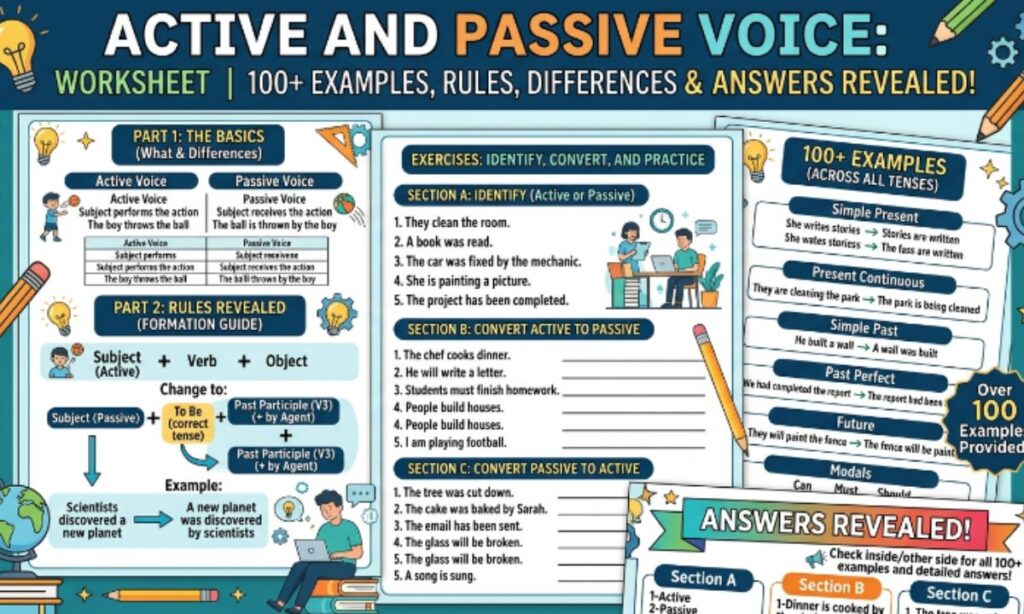
Active and passive voice often confuse students preparing for school exams, competitive tests, and everyday English writing. Knowing when to use active voice and when passive voice is more appropriate can instantly improve your writing clarity, tone, and grammar accuracy.
This guide breaks down active and passive voice in simple language, explains the rules with tense charts, gives you a printable-style worksheet to practice, and finishes with 100 solved examples so you never get confused again.
What is Active and Passive Voice?
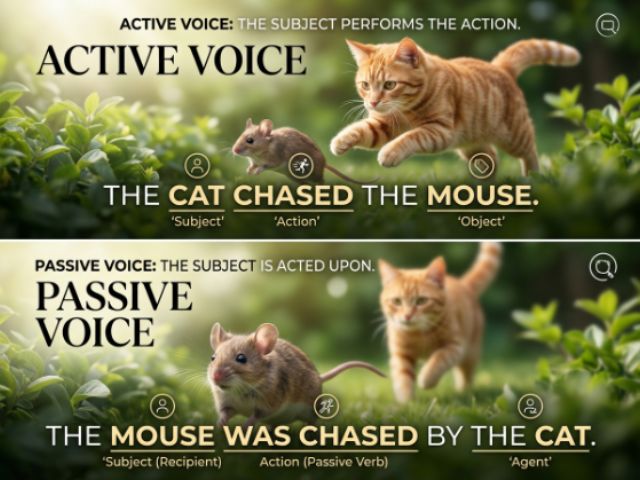
Active and passive voice are two different ways of arranging the same sentence, depending on whether the focus is on who does the action or who receives the action.
Active Voice
In active voice, the subject performs the action of the verb. The sentence follows a direct subject + verb + object pattern.
Example: Riya wrote a letter.
Here, Riya (subject) is doing the action (wrote).
Passive Voice
In passive voice, the subject receives the action instead of doing it. The object of the active sentence becomes the subject, and the verb changes to a form of “be” + past participle.
Example: A letter was written by Riya.
Here, the letter (subject) receives the action, and Riya becomes the agent introduced by “by.”
Active vs Passive Voice: Key Differences
| Feature | Active Voice | Passive Voice |
| Focus | On the doer of the action | On the receiver of the action |
| Sentence pattern | Subject + Verb + Object | Object + be + Past Participle + by + Subject |
| Tone | Direct, clear, concise | Formal, indirect |
| Common use | Everyday speech, storytelling | Reports, news, academic writing |
| Example | The chef cooked the meal. | The meal was cooked by the chef. |
Active and Passive Voice Rules
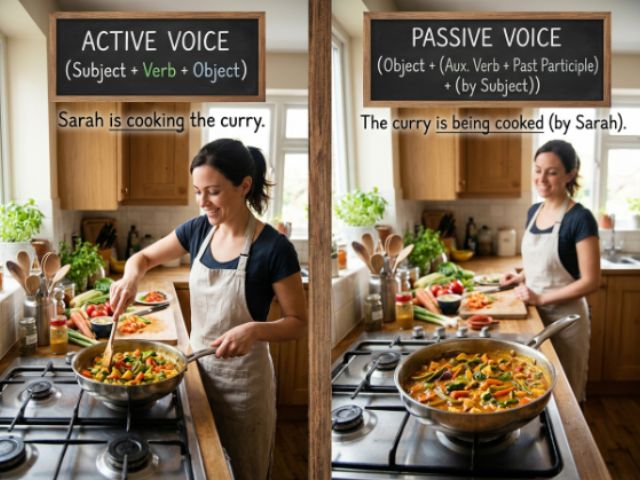
Converting a sentence between voices isn’t guesswork — it follows fixed grammar rules based on tense. Here are the core rules to remember.
General Rules for Conversion
- The object of the active sentence becomes the subject of the passive sentence.
- The subject of the active sentence becomes the agent, introduced by “by” (often optional).
- The main verb changes into its past participle (V3) form.
- An appropriate form of “be” (is, am, are, was, were, been, being) is added before the past participle.
- Only sentences with a transitive verb (a verb that takes an object) can be converted to passive voice. Intransitive verbs like “sleep,” “arrive,” or “laugh” cannot be made passive.
- The tense of the sentence never changes during conversion — only the structure changes.
Tense-Wise Passive Voice Structure
| Tense | Active Voice Structure | Passive Voice Structure |
| Simple Present | Subject + V1 + Object | Object + is/am/are + V3 + by + Subject |
| Present Continuous | Subject + is/am/are + V-ing + Object | Object + is/am/are + being + V3 + by + Subject |
| Present Perfect | Subject + has/have + V3 + Object | Object + has/have + been + V3 + by + Subject |
| Simple Past | Subject + V2 + Object | Object + was/were + V3 + by + Subject |
| Past Continuous | Subject + was/were + V-ing + Object | Object + was/were + being + V3 + by + Subject |
| Past Perfect | Subject + had + V3 + Object | Object + had + been + V3 + by + Subject |
| Simple Future | Subject + will/shall + V1 + Object | Object + will/shall + be + V3 + by + Subject |
| Future Perfect | Subject + will have + V3 + Object | Object + will have been + V3 + by + Subject |
| Modal Verbs | Subject + can/could/should + V1 + Object | Object + can/could/should + be + V3 + by + Subject |
| Imperative | V1 + Object | Let + Object + be + V3 (for requests) |
How to Convert Active Voice into Passive Voice
Follow these five steps whenever you convert a sentence:
- Identify the subject, verb, and object in the active sentence.
- Move the object to the front — it becomes the new subject.
- Change the verb into “be + past participle,” matching the original tense.
- Add “by” before the original subject (skip it if the doer is unknown or unimportant).
- Recheck subject-verb agreement in the new sentence.
Example walkthrough:
Active: The teacher explains the lesson.
Step 1: Subject = teacher, Verb = explains, Object = lesson
Step 2: Lesson becomes the new subject
Step 3: “explains” → “is explained”
Step 4: Add “by the teacher”
Result: The lesson is explained by the teacher.
Read More: Articles Worksheet for Class 2 in English Grammar | Pack of 3 Best Grammar Exercises
Convert Active Voice into Passive Voice: Worksheet
Try converting these sentences yourself before checking the answer key below.
- She writes a story.
- They are painting the wall.
- He has finished his homework.
- The workers built the bridge last year.
- She was cooking dinner.
- The manager had approved the leave.
- I will complete the project.
- Doctors will have treated the patient by then.
- You must submit the form.
- Close the door.
- My father drives the car.
- The teacher is checking the papers.
- She has written three books.
- They played football yesterday.
- The children were watching cartoons.
- He had repaired the bike before noon.
- We will host the event.
- She can solve this problem.
- Please open the window.
- The chef is preparing the salad.
Answer Key
- A story is written by her.
- The wall is being painted by them.
- His homework has been finished by him.
- The bridge was built by the workers last year.
- Dinner was being cooked by her.
- The leave had been approved by the manager.
- The project will be completed by me.
- The patient will have been treated by doctors by then.
- The form must be submitted by you.
- Let the door be closed.
- The car is driven by my father.
- The papers are being checked by the teacher.
- Three books have been written by her.
- Football was played by them yesterday.
- Cartoons were being watched by the children.
- The bike had been repaired by him before noon.
- The event will be hosted by us.
- This problem can be solved by her.
- Let the window be opened.
- The salad is being prepared by the chef.
Active and Passive Voice Examples with Answers: 100 Sentences
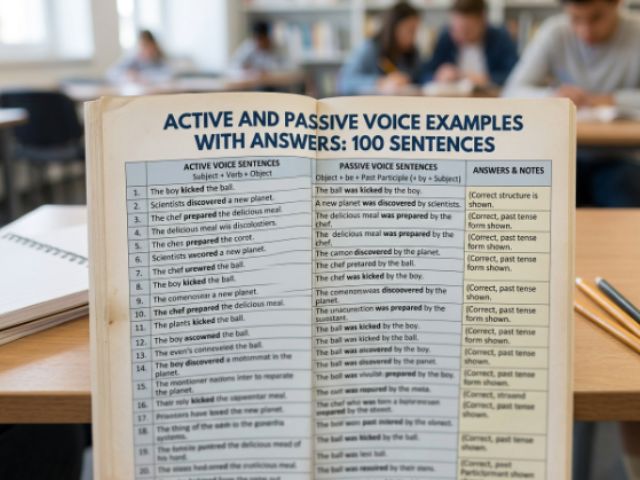
Here are 100 examples organized by tense so you can see the pattern clearly in each grammatical form.
| # | Active Voice | Passive Voice |
| 1 | The cat chases the mouse. | The mouse is chased by the cat. |
| 2 | She reads a book. | A book is read by her. |
| 3 | We clean the house every week. | The house is cleaned by us every week. |
| 4 | He plays the guitar. | The guitar is played by him. |
| 5 | I write letters. | Letters are written by me. |
| 6 | They deliver the mail daily. | The mail is delivered by them daily. |
| 7 | The farmer grows rice. | Rice is grown by the farmer. |
| 8 | She teaches English. | English is taught by her. |
| 9 | The dog barks at strangers. | Strangers are barked at by the dog. |
| 10 | Students submit assignments online. | Assignments are submitted online by students. |
| 11 | She is writing a letter. | A letter is being written by her. |
| 12 | They are building a school. | A school is being built by them. |
| 13 | He is fixing the car. | The car is being fixed by him. |
| 14 | I am reading the news. | The news is being read by me. |
| 15 | We are painting the fence. | The fence is being painted by us. |
| 16 | She has completed the task. | The task has been completed by her. |
| 17 | They have sold the house. | The house has been sold by them. |
| 18 | He has written a novel. | A novel has been written by him. |
| 19 | I have finished my project. | My project has been finished by me. |
| 20 | We have planted the trees. | The trees have been planted by us. |
| 21 | The boy kicked the ball. | The ball was kicked by the boy. |
| 22 | She baked a cake. | A cake was baked by her. |
| 23 | They watched a movie. | A movie was watched by them. |
| 24 | He wrote a letter. | A letter was written by him. |
| 25 | We visited the museum. | The museum was visited by us. |
| 26 | She was cooking lunch. | Lunch was being cooked by her. |
| 27 | They were repairing the road. | The road was being repaired by them. |
| 28 | He was painting the house. | The house was being painted by him. |
| 29 | I was reading a novel. | A novel was being read by me. |
| 30 | We were cleaning the yard. | The yard was being cleaned by us. |
| 31 | She had completed the exam. | The exam had been completed by her. |
| 32 | They had left before noon. | (Intransitive — no passive form) |
| 33 | He had written the report. | The report had been written by him. |
| 34 | I had finished the book. | The book had been finished by me. |
| 35 | We had painted the wall. | The wall had been painted by us. |
| 36 | She will write a book. | A book will be written by her. |
| 37 | They will build a bridge. | A bridge will be built by them. |
| 38 | He will fix the machine. | The machine will be fixed by him. |
| 39 | I will complete the form. | The form will be completed by me. |
| 40 | We will host the party. | The party will be hosted by us. |
| 41 | She will have finished the work. | The work will have been finished by her. |
| 42 | They will have sold the shop. | The shop will have been sold by them. |
| 43 | He will have repaired the fan. | The fan will have been repaired by him. |
| 44 | I will have written the essay. | The essay will have been written by me. |
| 45 | We will have completed the plan. | The plan will have been completed by us. |
| 46 | She can solve the puzzle. | The puzzle can be solved by her. |
| 47 | They must finish the task. | The task must be finished by them. |
| 48 | He should clean the room. | The room should be cleaned by him. |
| 49 | I might write the email. | The email might be written by me. |
| 50 | We could build the shed. | The shed could be built by us. |
| 51 | Open the door. | Let the door be opened. |
| 52 | Close the window. | Let the window be closed. |
| 53 | Submit the report. | Let the report be submitted. |
| 54 | Turn off the lights. | Let the lights be turned off. |
| 55 | Feed the dog. | Let the dog be fed. |
| 56 | The workers repair the road. | The road is repaired by the workers. |
| 57 | The nurse checks the patient. | The patient is checked by the nurse. |
| 58 | She sings a song. | A song is sung by her. |
| 59 | He drives the truck. | The truck is driven by him. |
| 60 | We plant flowers every spring. | Flowers are planted by us every spring. |
| 61 | The teacher explains the lesson. | The lesson is explained by the teacher. |
| 62 | She solves the equation. | The equation is solved by her. |
| 63 | They organize the event. | The event is organized by them. |
| 64 | He designs websites. | Websites are designed by him. |
| 65 | I prepare the report. | The report is prepared by me. |
| 66 | She is baking cookies. | Cookies are being baked by her. |
| 67 | They are cleaning the office. | The office is being cleaned by them. |
| 68 | He is washing the car. | The car is being washed by him. |
| 69 | I am writing an email. | An email is being written by me. |
| 70 | We are decorating the hall. | The hall is being decorated by us. |
| 71 | She has painted the picture. | The picture has been painted by her. |
| 72 | They have completed the survey. | The survey has been completed by them. |
| 73 | He has repaired the phone. | The phone has been repaired by him. |
| 74 | I have cooked dinner. | Dinner has been cooked by me. |
| 75 | We have organized the files. | The files have been organized by us. |
| 76 | The girl drew a picture. | A picture was drawn by the girl. |
| 77 | They built the tower. | The tower was built by them. |
| 78 | He caught the ball. | The ball was caught by him. |
| 79 | I found the keys. | The keys were found by me. |
| 80 | We solved the problem. | The problem was solved by us. |
| 81 | She was writing the essay. | The essay was being written by her. |
| 82 | They were painting the fence. | The fence was being painted by them. |
| 83 | He was fixing the bike. | The bike was being fixed by him. |
| 84 | I was reading the newspaper. | The newspaper was being read by me. |
| 85 | We were watching the game. | The game was being watched by us. |
| 86 | She had finished the assignment. | The assignment had been finished by her. |
| 87 | They had built the wall. | The wall had been built by them. |
| 88 | He had cooked the meal. | The meal had been cooked by him. |
| 89 | I had written the note. | The note had been written by me. |
| 90 | We had cleaned the garden. | The garden had been cleaned by us. |
| 91 | She will teach the class. | The class will be taught by her. |
| 92 | They will paint the house. | The house will be painted by them. |
| 93 | He will write the article. | The article will be written by him. |
| 94 | I will clean the room. | The room will be cleaned by me. |
| 95 | We will plan the trip. | The trip will be planned by us. |
| 96 | She must complete the form. | The form must be completed by her. |
| 97 | They should follow the rules. | The rules should be followed by them. |
| 98 | He can repair the engine. | The engine can be repaired by him. |
| 99 | I may write the summary. | The summary may be written by me. |
| 100 | We should finish the project. | The project should be finished by us. |
Common Mistakes to Avoid
- Changing the tense while converting the voice.
- Trying to make intransitive verbs (like “arrive,” “sleep,” “happen”) passive.
- Forgetting subject-verb agreement in the new sentence.
- Overusing passive voice in everyday writing, which can sound unnatural or weak.
- Dropping “by + agent” when the doer is actually important to the meaning.
Conclusion
Active and passive voice are simple once you understand the core rule: active voice puts the doer first, while passive voice puts the receiver first. Practicing with a structured worksheet, memorizing the tense charts, and reviewing solved examples is the fastest way to master this topic. Use the 100 examples and worksheet above as a quick daily practice tool, and you’ll be converting sentences confidently in no time.
FAQs
What is the easiest way to identify passive voice?
Look for a form of “be” (is, was, were, been) followed by a past participle, often with “by” naming the doer.
Can every active sentence be converted to passive?
No, only sentences with transitive verbs (verbs that take a direct object) can be converted to passive voice.
When should I use passive voice instead of active voice?
Use passive voice when the doer is unknown, unimportant, or when you want to emphasize the action or result rather than who performed it.
Is passive voice grammatically incorrect?
No, passive voice is grammatically correct; it’s simply more formal and indirect than active voice.
Why is active voice preferred in most writing?
Active voice is preferred because it’s clearer, more concise, and easier for readers to follow.
Leave a Reply