TLDR Meaning: What Does TLDR Mean in Text & Social Media?
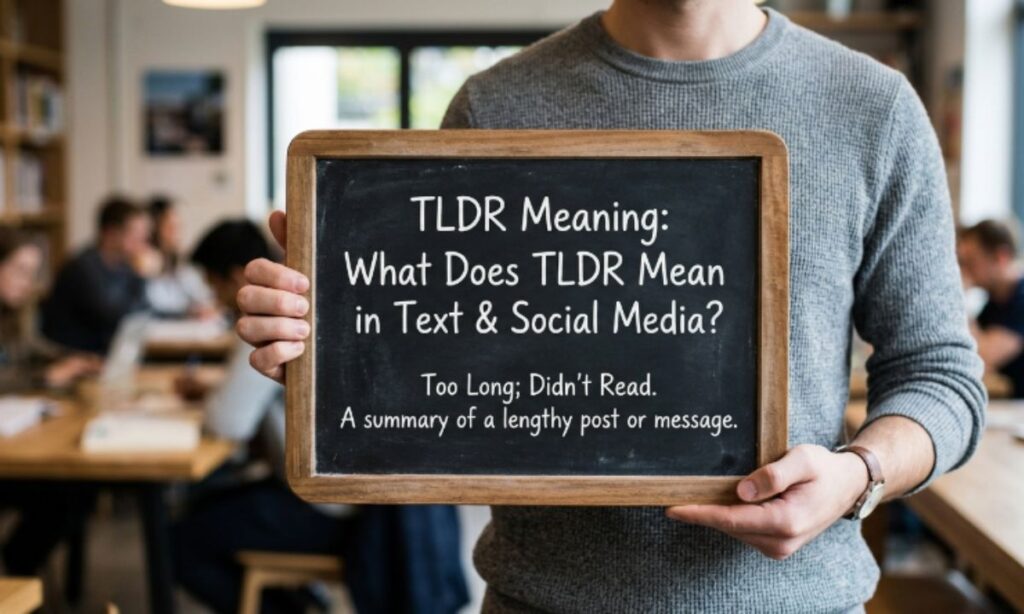
If you’ve spent any time scrolling Reddit, Twitter/X, or even your work Slack, you’ve probably run into the letters TLDR. It shows up in comments, articles, emails, and texts, but if you’re new to the term, it can look like a random keyboard mash. It isn’t. TLDR is one of the internet’s most useful shortcuts, and once you know what it means, you’ll start noticing it everywhere.
This guide breaks down exactly what TLDR stands for, where it came from, how to use it correctly, and the mistakes to avoid so you don’t sound out of touch online.
What Does TLDR Stand For?
TLDR stands for “Too Long; Didn’t Read.” It’s an internet initialism, meaning each letter is pronounced individually (tee-el-dee-are) rather than as one word.
You’ll also see it written as TL;DR, with a semicolon separating the two ideas: the text was too long, and the person didn’t read it in full. Both spellings mean the same thing, and both are widely accepted in casual and even professional writing.
At its core, TLDR does one of two things:
- Points out that a piece of writing is lengthy
- Introduces a summary so readers can skip the details and get the main point
TLDR Meaning in Text Messages
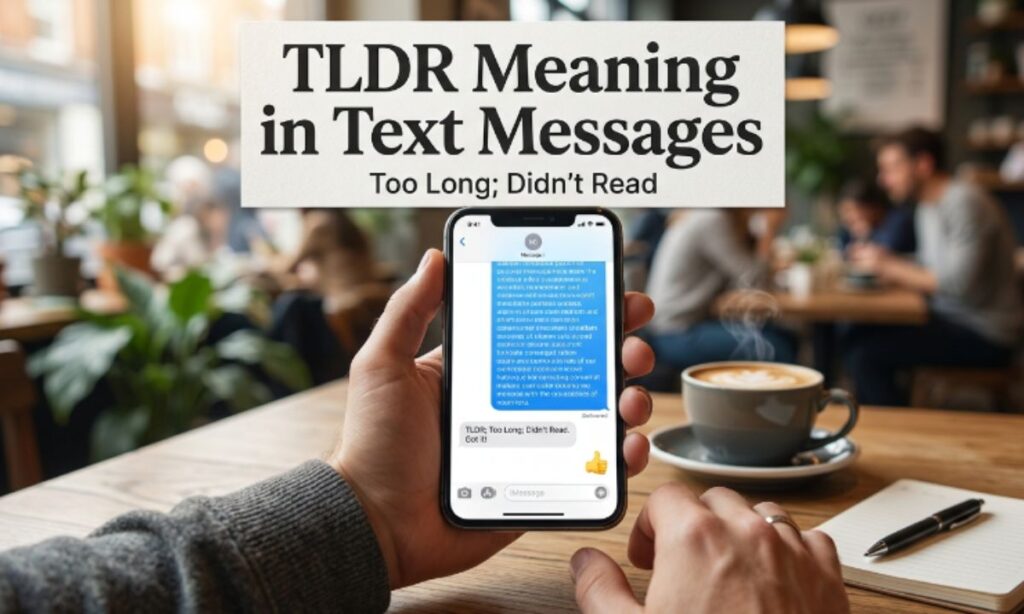
In text messages, TLDR usually works as a quick summary tag. Instead of making a friend read three paragraphs about your weekend, you might text the long version first, then add a short recap.
Example:
“Ok so the trip got complicated, flight got delayed, we missed the hotel check-in, had to book a new place last minute… TLDR: we’re safe, just exhausted.”
In texting, TLDR can also be used as a request. If someone sends you a wall of text, replying “TLDR?” is a casual way of asking for the short version without sounding rude, as long as you know the person well.
What Does TLDR Mean on Social Media (Instagram, TikTok, Reddit)?
TLDR shows up slightly differently depending on the platform, but the meaning stays consistent: a condensed version of a longer message.
| Platform | Common Use of TLDR |
| Posted at the top or bottom of long threads to summarize the main argument or story before the details | |
| Used in long captions, especially personal stories or announcements, to give a quick takeaway | |
| TikTok | Appears in comments or captions under videos with lengthy explanations, or as a joke about a long video |
| Twitter/X | Used in threads to sum up a multi-tweet explanation in one line |
Reddit deserves special mention here, since it’s widely credited as the platform where TLDR became a normal, expected part of long posts. Many subreddits with lengthy story-based content (like relationship or advice communities) practically require a TLDR at the top so people can decide if they want to keep reading.
Where Did TLDR Come From? A Quick History
TLDR isn’t a brand-new term. It has roots in early internet and forum culture, long before smartphones existed.
- It started as internet and email slang used to flag that a portion of a message was skipped because it was too long.
- It gained real traction on forums and message boards in the early-to-mid 2000s, often as a blunt, sometimes sarcastic reply to overly long posts.
- Reddit’s growth in the late 2000s and 2010s helped normalize TLDR as a standard formatting habit, not just a snarky comment.
- The term eventually became mainstream enough to be recognized by major dictionaries, including Merriam-Webster, which added it as an official entry in 2018.
What began as a dismissive jab (“your post was too long, I skipped it”) gradually evolved into something far more constructive: a courtesy summary that writers add on purpose to help their readers.
How to Use TLDR in a Sentence
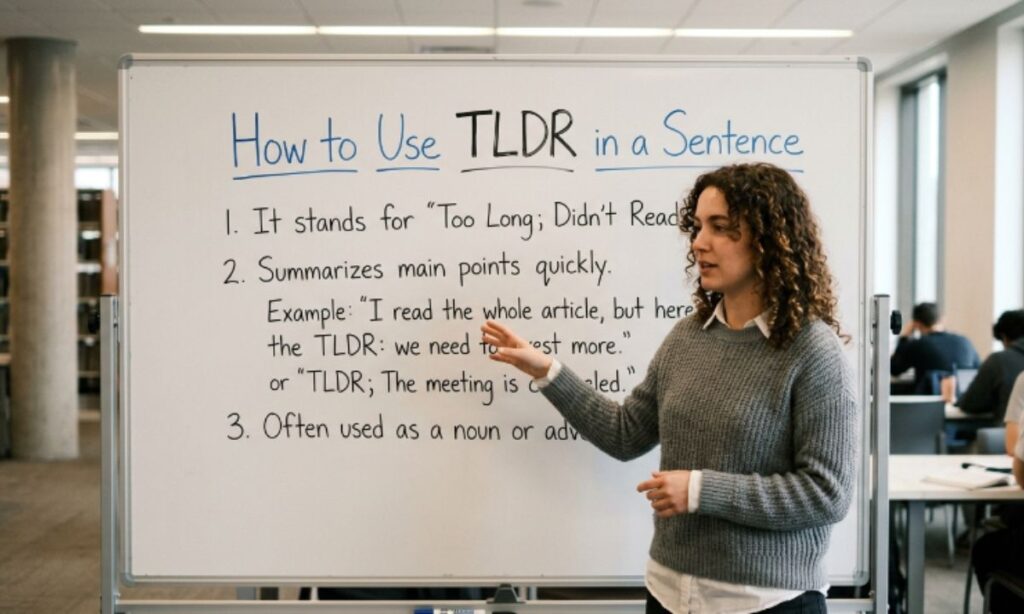
TLDR is flexible. It can appear at the start of a message, the end, or as a one-word reply. Here are a few natural ways to use it:
- As an intro: “TLDR: the new update fixes the login bug but adds a few new bugs elsewhere.”
- As a closer: “…so overall it was a really long process. TLDR we got the apartment!“
- As a question: “This article is huge, TLDR?”
- As a label: “TLDR version: don’t buy the cheap version, it breaks in a month.”
Grammatically, TLDR functions almost like a label or a mini heading rather than a full sentence, so it’s usually followed by a colon and a short statement.
TLDR vs TL;DR: Is There a Difference?
Not really. There’s no meaningful difference in meaning between TLDR and TL;DR the semicolon is purely stylistic.
| Version | Notes |
| TL;DR | The more traditional, “correct” form with punctuation matching the original phrase structure |
| TLDR | A simplified, faster-to-type version common in texting and casual typing |
Some style guides and dictionaries list TL;DR as the primary form, with TLDR as an accepted variant. In everyday use, especially in texting and social media, you can use either one without worrying about being “wrong.”
Read More: 67 Meaning: What Does 67 Mean? Angel Number, Spiritual & Slang Meaning
When Is It Appropriate to Use TLDR?
TLDR works best when it genuinely helps the reader. It’s less appropriate when it comes across as lazy or dismissive.
Good times to use TLDR:
- You’re writing a long post, email, or caption and want to give readers a quick summary upfront
- Someone asks for a shorter version of something you wrote
- You’re summarizing a long discussion thread for people who are catching up
Times to avoid it:
- As a rude, standalone reply to someone’s genuine, effortful writing
- In formal documents or professional reports where a proper executive summary is expected instead
- Repeatedly, in a way that discourages people from ever reading your full message
TLDR Examples in Real Conversations
Here’s how TLDR looks in different everyday contexts:
- Work email: “TLDR: the client approved the budget, but we need the revised timeline by Friday.”
- Group chat: “Ugh long story short, TLDR my flight got cancelled, I’ll be a day late.”
- Reddit post title/comment: “TLDR: switched careers at 30, no regrets, happy to answer questions.”
- Product review: “TLDR great sound quality, mediocre battery life, worth it for the price.”
Notice the pattern: TLDR is followed by a short, punchy statement that captures the essential point, not every detail.
How to Write a Good TLDR Summary
A strong TLDR isn’t just short, it’s genuinely useful. Follow these tips to write one that actually helps your reader:
- Keep it to 1–2 sentences. If your summary is a paragraph, it’s not really a TLDR anymore.
- Lead with the outcome or main point, not the background story.
- Cut adjectives and filler words. Stick to facts or conclusions.
- Place it strategically at the top for impatient readers, at the bottom if you want people to read the full piece first.
- Make it stand alone. Someone should understand your TLDR even if they read nothing else.
Common Mistakes People Make When Using TLDR
Even though TLDR is simple, people misuse it in a few predictable ways:
- Using it as a lazy insult : replying “TLDR” with nothing else to dismiss someone’s writing can come across as rude.
- Writing a TLDR that’s still too long : if your summary is five sentences, it defeats the purpose.
- Leaving out the actual point : some TLDRs summarize the topic (“this post is about my job”) instead of the conclusion (“I got the promotion”).
- Overusing it in professional writing : in formal settings, “Summary” or “Key Takeaways” often reads better than TLDR.
Other Popular Texting Abbreviations Like TLDR
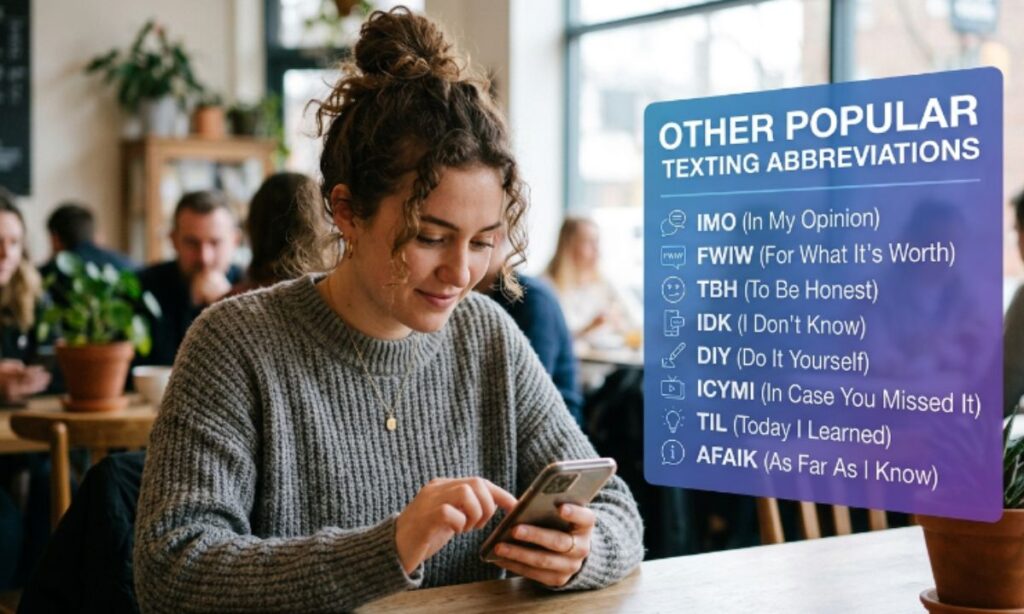
TLDR belongs to a broader family of internet shorthand. A few common ones you’ll see alongside it:
| Abbreviation | Meaning |
| IMO / IMHO | In my opinion / In my humble opinion |
| FYI | For your information |
| NGL | Not gonna lie |
| IIRC | If I recall correctly |
| AFAIK | As far as I know |
| ELI5 | Explain like I’m 5 |
Like TLDR, these terms exist mainly to save time and keep casual conversations efficient.
Conclusion
TLDR (“Too Long; Didn’t Read”) has grown from a blunt forum comment into one of the most practical tools in online writing. Whether you’re texting a friend, posting on Reddit, or wrapping up a long work email, a well-written TLDR respects your reader’s time while still getting your point across. The key is using it thoughtfully: keep it short, lead with the point, and save it for situations where a summary actually adds value.
TLDR FAQs: Quick Answers to Common Questions
What does TLDR mean in a text?
It means “Too Long; Didn’t Read” and usually introduces a short summary of a longer message.
Is TLDR rude to say?
It can be, if used as a dismissive standalone reply, but it’s generally seen as helpful when paired with an actual summary.
Do you need a semicolon in TL;DR?
No, both TL;DR and TLDR are acceptable; the semicolon is a stylistic choice, not a rule.
Is TLDR a real word in the dictionary?
Yes, TL;DR was added to Merriam-Webster in 2018 and is recognized as an accepted term.
How long should a TLDR summary be?
Ideally one to two sentences, just enough to capture the main point.
Can I use TLDR in professional emails?
Yes, though in very formal documents, “Summary” or “Key Takeaways” may sound more polished.
Leave a Reply