Winning or Wining? The Powerful Spelling Guide 2026
If you’ve ever typed a sentence and paused, finger hovering over the keyboard, wondering whether it’s “winning” or “wining,” you’re not alone. This is one of the most common spelling mix-ups in English, and it trips up native speakers just as often as learners. The gap between these two words is a single letter, but the meanings couldn’t be more different.
In this guide, you’ll get a clear, no-fluff breakdown of both words, when to use each one, and simple tricks to make sure you never confuse them again.
Quick Answer
Winning means achieving success or victory — it comes from the verb “win.” Wining means serving or drinking wine, usually as part of entertaining guests — it comes from the noun/verb “wine.”
- Use winning for sports, competitions, awards, business success, or personal achievement.
- Use wining almost exclusively in the phrase “wining and dining,” meaning to treat someone to food, drinks, and hospitality.
If you’re unsure which one you need, ask yourself: Am I talking about success, or am I talking about wine? That one question solves 99% of the confusion.
Quick Comparison Table
| Feature | Winning | Wining |
| Root word | Win | Wine |
| Meaning | Achieving victory or success | Serving/drinking wine, entertaining guests |
| Part of speech | Verb (present participle), adjective, noun | Verb (present participle) |
| Common usage | Sports, business, exams, games | Hospitality, dining, socializing |
| Frequency | Very common | Rare, mostly in “wining and dining” |
| Example sentence | She is winning the match. | They were wining and dining the clients. |
| Spelling rule | Double “n” (CVC rule) | Single “n” (silent “e” drop) |
Deep Dive: Winning
“Winning” is the present participle of the verb win, which traces back to Old English roots meaning to gain, earn, or achieve through effort. It’s one of the most frequently used words in the English language because it applies to nearly every competitive or goal-driven situation.
Winning can function in three different ways:
- As a verb : describing the ongoing action of achieving victory.
Example: Our team is winning by ten points. - As an adjective : describing something connected to success.
Example: She had a winning smile that lit up the room. - As a noun (usually plural) : referring to money or prizes gained, especially through gambling.
Example: He used his winnings to pay off his debt.
Because “winning” follows the standard English doubling rule (a short vowel followed by a single consonant before adding “-ing” usually doubles that consonant), the “n” in “win” becomes “nn” in “winning.” That’s the same pattern you see in words like “running,” “planning,” and “swimming.”
Why “Winning” Uses a Double N
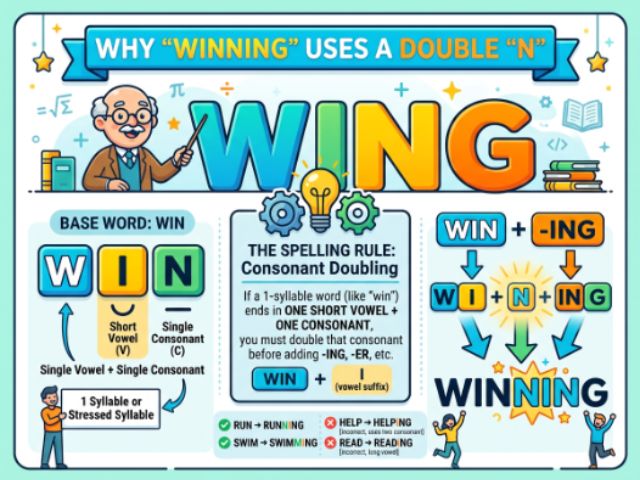
The rule is simple once you see it laid out:
- Win = one syllable, short vowel “i,” ends in a single consonant “n.”
- Add “-ing” → double the final consonant → winning.
This is a standard spelling pattern in English, and recognizing it can help you spell dozens of other similar words correctly too.
Deep Dive: Wining
“Wining” comes from the noun wine, turned into a verb meaning to serve or treat someone to wine, usually in a social or hospitable setting. Unlike “winning,” this word is rarely used on its own. It almost always appears alongside “dining” in the popular expression “wining and dining.”
- The executives spent the evening wining and dining potential investors.
- She loves wining her guests at every dinner party.
- The hotel offered a wining and dining package for the weekend getaway.
Why “Wining” Drops the Silent E
“Wine” ends in a silent “e.” When you add “-ing” to a word ending in a silent “e,” standard spelling rules say you drop the e before adding the suffix. That’s why:
- Wine → Wining (not “wineing”)
This same rule applies to words like “write” → “writing” and “hope” → “hoping.”
You Are Winning Meaning
When someone says “you are winning,” they’re telling you that you’re currently ahead, succeeding, or performing better than expected in a given situation. This phrase is used in several contexts:
- Competitive contexts: You’re leading in a game, race, or match.
- Everyday encouragement: You’re doing well in life, work, or a personal challenge (e.g., “You’re winning at adulting”).
- Casual/sarcastic tone: Sometimes used humorously to acknowledge a small victory, like finding a parking spot right away.
In every case, “you are winning” always relates to success — never to wine or hospitality.
Winning or Wining Synonym

Since these two words mean completely different things, their synonyms don’t overlap at all.
Synonyms for winning:
- Succeeding
- Triumphing
- Prevailing
- Achieving
- Dominating
- Prospering
Synonyms for wining:
- Entertaining (with drinks)
- Hosting
- Treating
- Feasting
- Socializing (with wine involved)
If a synonym relates to victory or achievement, you need “winning.” If it relates to hospitality, drinks, or entertaining guests, you need “wining.”
Key Differences & Golden Rule to Remember
Here’s a simple breakdown of what separates these two words:
| Aspect | Winning | Wining |
| Origin | Win (to succeed) | Wine (the drink) |
| Context | Competitions, achievements | Hospitality, socializing |
| Common phrase | Winning streak, winning strategy | Wining and dining |
| Letter count | Double “n” | Single “n” |
The Golden Rule
Two N’s, means you WON something. One N, means you’re drinking WINE.
This simple memory trick works because “winning” has that extra “n” just like the word “win” itself has one “n” that gets doubled — while “wining” keeps things simple with a single “n,” just like “wine.”
Real-World Context & Usage Examples
Seeing these words in real sentences makes the difference much easier to internalize.
Winning in real life:
- The startup is winning new customers every month through smart marketing.
- Her winning attitude helped the entire team stay motivated.
- After years of hard work, he finally tasted the sweetness of winning.
Wining in real life:
- The sales team is known for wining and dining potential partners before closing deals.
- Restaurants often host wining events to promote new vineyard collections.
- They spent the anniversary wining and dining at a rooftop restaurant.
Notice that “wining” almost never appears without “dining” close by — that’s a strong contextual clue that can help you double-check your writing.
Common Mistakes to Avoid
- Dropping the second “n” in winning. Fast typing and autocorrect often turn “winning” into “wining” by accident, especially on mobile devices.
- Using “wining” outside of hospitality contexts. If you’re not talking about wine or entertaining guests, you almost certainly need “winning.”
- Assuming spell-check will catch the error. Since both words are spelled correctly on their own, spell-checkers won’t flag a wrong word choice — only grammar-focused tools might catch it.
- Forgetting the doubling rule. Misapplying the CVC (consonant-vowel-consonant) rule can lead to errors in similar words like “running,” “planning,” or “shopping.”
- Overlooking context while proofreading. Always reread your sentence and ask: does this relate to success or to wine?
Frequently Asked Questions
Is “wining” a real word?
Yes. “Wining” is a real English word meaning to serve or entertain someone with wine, most often used in the phrase “wining and dining.”
What is the correct spelling for winning a game?
The correct spelling is “winning,” with a double “n,” since it relates to achieving victory or success.
Why do people confuse winning and wining?
The words differ by only one letter and can sound similar in fast speech, and spell-check tools often don’t catch the mistake since both are valid words.
Can “wining” ever mean the same as “winning”?
No. They have entirely different meanings — winning relates to success, while wining relates to wine and hospitality.
What does “wining and dining” mean?
It means treating someone generously to food, drinks, and entertainment, usually to build a relationship or impress them.
Conclusion
The difference between winning and wining comes down to one extra letter — but that single “n” changes the entire meaning of your sentence. Winning is all about success, achievement, and victory, while wining is tied to wine, hospitality, and entertaining guests.
The next time you’re unsure which word to use, remember the golden rule: two N’s for victory, one N for wine. With this simple trick in mind, you’ll never mix up these two words again, whether you’re writing an email, a report, or a casual text message.
Leave a Reply