How to Gauge Interest: What It Means, When to Use It, and Why It Matters
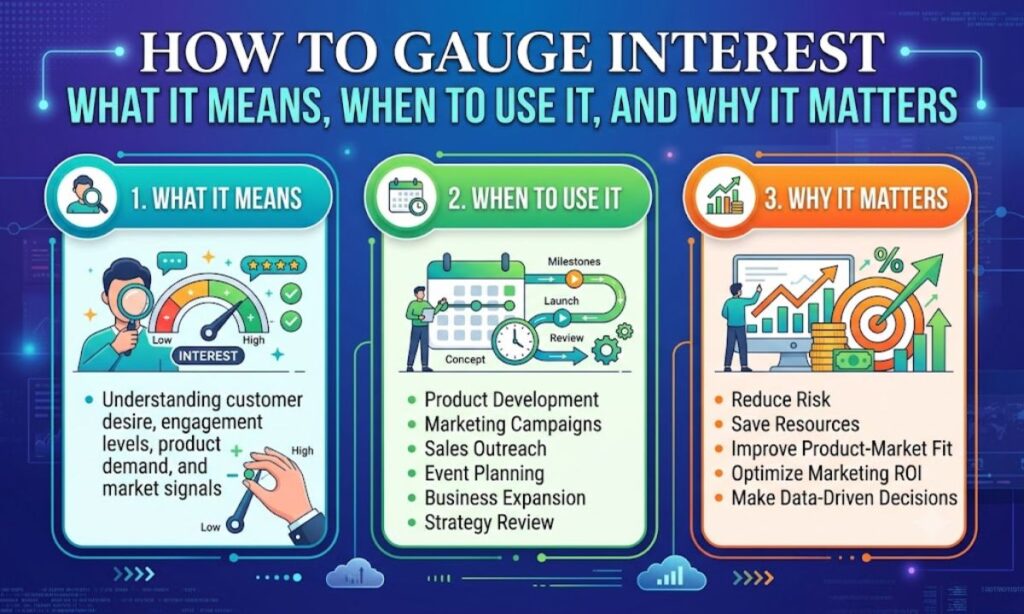
You have an idea. Maybe it’s a new product, a side hustle, a workshop topic, or a question you want to ask your boss. Before you spend money, time, or credibility on it, you want one thing: proof that people actually care.
That’s where the phrase gauge interest comes in. It shows up in marketing meetings, product launches, event planning, and even everyday conversations. But what does it really mean, where did it come from, and how do you actually do it well?
This guide breaks down the meaning, origin, and practical use of “gauge interest,” so you can use the phrase correctly and apply the strategy effectively.
Gauge Meaning: What Does “Gauge Interest” Actually Mean?
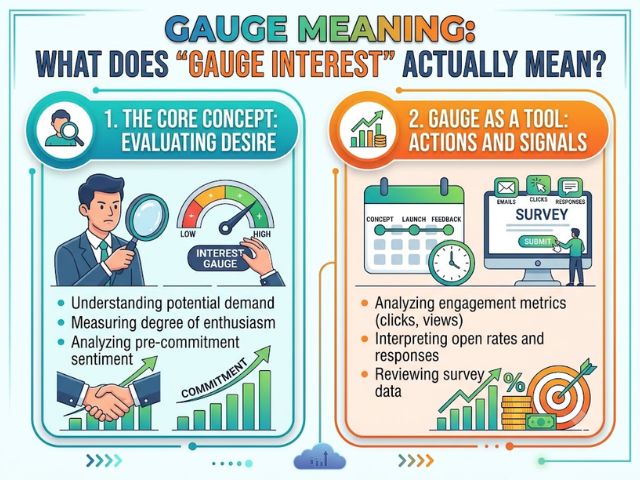
To gauge interest means to measure, estimate, or assess how much enthusiasm, curiosity, or willingness people have toward an idea, product, event, or opportunity — before committing to it fully.
Think of the word “gauge” the way you’d think of a fuel gauge in a car. It doesn’t fill the tank. It just tells you how much is there. In the same way, gauging interest doesn’t create demand or force a decision. It simply reveals where people already stand.
So when someone says, “Let’s gauge interest before we build this,” they mean: let’s check if people actually want this before we invest real resources into it.
In short:
- Gauge = to measure, assess, or estimate
- Interest = enthusiasm, curiosity, or willingness
- Gauge interest = to test how much people care before acting
Where Did This Expression Come From?
The word “gauge” traces back to the Old French term jauge, which referred to a measuring rod or tool used to assess the size, capacity, or quantity of something — often liquids in barrels or containers. Over centuries, English absorbed the word and broadened its meaning beyond physical measurement.
Today, “gauge” applies just as easily to abstract concepts as it does to physical ones. You can gauge:
- Temperature (a thermostat)
- Fuel levels (a fuel gauge)
- Public opinion
- Emotional reactions
- Market demand
- Interest in an idea or product
That shift — from measuring physical materials to measuring human attitudes — is exactly how “gauge interest” became a common phrase in business, marketing, and everyday conversation. It’s worth noting that the correct spelling is “gauging interest,” not “gaging interest.” The word “gage” exists, but it carries a different, largely archaic meaning tied to pledges or challenges, not measurement.
Why Do People Gauge Interest Before Acting?

Gauging interest matters because it lowers risk. Instead of guessing whether people want something, you collect actual signals first. This applies whether you’re launching a product, planning an event, or even asking someone out.
Here’s why professionals and everyday people rely on this step:
- It saves time and money. Building a product nobody wants is expensive. A quick interest check avoids wasted development hours.
- It reduces the fear of rejection. Testing the waters feels safer than a full, public commitment.
- It improves decision-making. Real feedback beats assumptions every time.
- It builds early momentum. People who show interest early often become your first customers or supporters.
- It validates timing. Sometimes an idea is good, but the timing is off. Gauging interest reveals that too.
In business terms, this is closely tied to the idea of validating demand before investing in supply.
Real-Life Examples of Gauge Interest
Seeing the phrase in action makes the meaning click faster. Here are common, real-world scenarios:
- Business: A company sends a short survey to its email list to gauge interest in a new subscription tier before building it.
- Startups: A founder posts a simple landing page with a “Notify Me” button to gauge interest in an unreleased app.
- Education: A teacher asks students a quick poll question to gauge interest in a new elective before finalizing the course.
- Events: An organizer creates a sign-up form to gauge interest in a workshop before booking a venue.
- Finance: A bank circulates a teaser document among potential bidders to gauge interest in an upcoming deal.
- Workplace: A manager floats an idea informally in a meeting to gauge interest before writing a full proposal.
- Personal life: Someone mentions a weekend trip idea to friends casually, just to gauge interest before planning details.
Notice the pattern: in every example, the action is small, low-cost, and reversible. That’s the whole point of gauging interest — testing before committing.
Gauge Interest vs. Test the Market: What Is the Difference?
These two phrases often get used interchangeably, but they’re not quite the same thing. Gauging interest usually comes first; testing the market comes after.
| Aspect | Gauge Interest | Test the Market |
| Main question | “Does anyone care?” | “Will people actually pay or act?” |
| Stage | Early, exploratory | Later, more advanced |
| Cost | Low or free | Moderate to significant |
| Method | Polls, surveys, conversations | Pilot launches, paid ads, pre-orders |
| Commitment level | Minimal | Higher, closer to real launch |
| Outcome | Rough interest level | Real demand and purchase behavior |
In simple terms: you gauge interest to see if an idea is worth pursuing at all. You test the market to see if people will actually pay for it once it exists. Skipping straight to market testing without gauging interest first often wastes resources on ideas that never had real appeal.
How to Gauge Interest Effectively
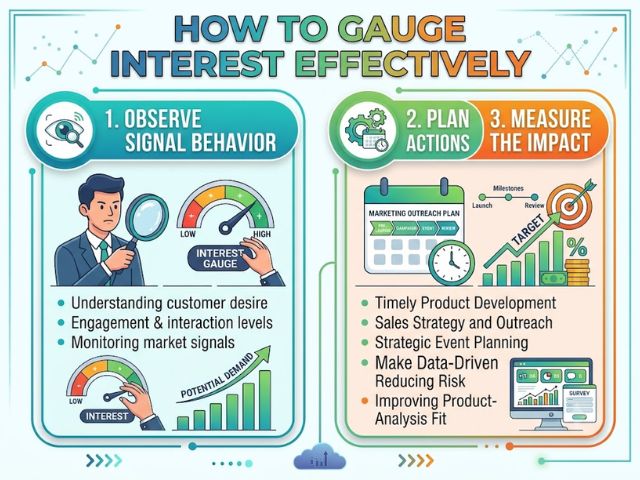
Knowing the definition is one thing. Doing it well is another. Here’s a practical approach that works across business, education, and personal situations.
Ask a Clear, Specific Question
Vague questions produce vague answers. Instead of “Would you like something like this?” try something concrete: “Would you pay $15 a month for a tool that saves you two hours of admin work weekly?” Specific questions generate honest, usable data.
Use Multiple Channels
Don’t rely on a single email or one conversation. Combine methods such as:
- Short online surveys
- Social media polls
- Direct one-on-one conversations
- Simple landing pages with sign-up forms
- Phone calls or informal chats
Different channels reach different people, and combining them gives a fuller picture.
Read More:BFN Meaning in Text: What It Really Means and How to Use It Right
Watch Behavior, Not Just Words
People often say they’re interested to be polite. Real signals come from action: Did they click the link? Did they sign up? Did they share it with someone else? Behavior tends to be more honest than verbal agreement.
Set a Simple Benchmark
Before you collect responses, decide what counts as “enough” interest. For example, 50 sign-ups in a week might justify moving forward, while five might not. Having a benchmark in advance prevents biased interpretation later.
Keep It Low-Pressure
The goal is honest feedback, not a sales pitch. Avoid leading questions or overly enthusiastic framing that nudges people toward a positive answer.
Common Mistakes When Trying to Gauge Interest
Even well-intentioned attempts to gauge interest can go wrong. Watch out for these frequent errors:
- Asking leading questions. Framing a question to get the answer you want defeats the purpose.
- Relying on a tiny sample size. Ten responses from close friends won’t reflect a real market.
- Confusing politeness with genuine interest. “That sounds nice” is not the same as “I would use this.”
- Ignoring silence. No response is still a response — often a sign of low interest.
- Skipping follow-up questions. A simple yes/no misses the “why,” which is often more valuable than the answer itself.
- Acting only on the loudest voices. A few vocal supporters can create a false sense of broad interest.
Phrases Similar to “Gauge Interest” You Should Know
Expanding your vocabulary helps you sound natural and avoid repetition in professional writing. Common alternatives include:
- Assess interest
- Measure interest
- Test the waters
- Take the temperature
- Sound out
- Get a read on
- Feel out the situation
- Canvas opinion
Each of these carries the same core idea: checking enthusiasm or willingness before making a bigger move.
When Should You NOT Gauge Interest?

Gauging interest is useful, but it’s not always the right step. Skip it, or move past it quickly, in these situations:
- When the stakes are extremely low. Small, reversible decisions don’t need formal validation.
- When timing is critical. If an opportunity is time-sensitive, spending too long gauging interest can cause you to miss it entirely.
- When you already have strong data. If you’ve already tested something similar successfully, repeating the step may be unnecessary.
- When the decision isn’t really up for debate. Gauging interest on something that’s already been decided can feel dishonest or performative.
Which Phrase Should You Use in Professional Writing?
In professional or formal writing, “gauge interest” is the standard, widely accepted phrase. Avoid the variant “gage interest,” which reads as a spelling error to most readers, even though “gage” is technically an older English word with an unrelated meaning.
For variety, professional writers sometimes alternate with “assess interest” or “measure interest,” especially in reports or formal proposals. Casual alternatives like “test the waters” work well in blogs, emails, or conversational content but are less suited to formal business documents.
Frequently Asked Questions
What does it mean to gauge interest?
It means to measure or estimate how much enthusiasm or willingness people have toward an idea before committing to it fully.
Is it “gauge interest” or “gage interest”?
“Gauge interest” is correct. “Gage” is a different, largely outdated word unrelated to measurement.
Why do businesses gauge interest before launching a product?
They do it to avoid wasting time and money building something nobody actually wants.
What’s a simple way to gauge interest quickly?
A short survey, poll, or landing page sign-up form usually gives fast, useful signals.
Is gauging interest the same as market research?
Not exactly. Gauging interest is an early, informal step, while market research is broader and more detailed.
Can gauging interest be wrong or misleading?
Yes, especially with small sample sizes, leading questions, or confusing polite responses with real commitment.
The Final Word
Gauging interest is a small step with a big payoff. It replaces guesswork with real signals, helping you avoid wasted effort on ideas nobody wants, while giving genuinely promising ideas the confidence boost they need to move forward.
Whether you’re launching a product, planning an event, or simply floating an idea to friends, the principle stays the same: ask clearly, listen honestly, and watch what people actually do — not just what they say. Do that consistently, and you’ll make sharper, more confident decisions every time.
Leave a Reply