

You’re mid-conversation, you send something you thought deserved a real reaction, and all you get back is: “hn.”
No punctuation. No emoji. No context.
Is that an agreement? Boredom? Are they annoyed? Did they mean to type something else and just… stop?
If you’ve ever stared at those two letters trying to decode someone’s mood, you’re not alone. “Hn” has quietly become one of the most common and most misunderstood replies in modern texting, WhatsApp chats, Discord servers, and Instagram DMs. It looks like nothing, but it can carry a surprising amount of emotional weight.
This guide breaks down exactly what “hn” means, how it changes depending on tone and platform, and how to respond to it without overthinking (or underthinking) the moment.
What does “hn” Mean in Text?
At its core, “hn” is a text-based version of a vocal sound the short, closed-mouth “hmm” or grunt people make when they’re thinking, hesitating, mildly acknowledging something, or reacting without committing to a full response.
It’s not a formal abbreviation with one fixed meaning, the way “brb” means “be right back.” Instead, “hn” behaves more like a verbal filler translated into text — similar to how “uh,” “hmm,” or “meh” work in spoken conversation. That’s exactly why it confuses so many people: there’s no dictionary entry that nails it down, because its meaning is carried almost entirely by tone, timing, and relationship context.
Broadly, “hn” tends to fall into one of these buckets:
| Core Meaning | What It Signals | Typical Tone |
| Thinking / hesitating | “Let me consider that” | Neutral |
| Casual acknowledgment | “Okay, noted” | Neutral to warm |
| Short for “Hell No” | Firm rejection | Blunt, sometimes playful |
| Passive disinterest | “I don’t really care” | Cold, dismissive |
| Flirty low-key response | “I’m listening, keep going” | Playful, teasing |
The single most important thing to understand about “hn” is this: it is a context-dependent sound, not a fixed-meaning word. The same two letters can mean “I hear you,” “no way,” or “I’m not that interested,” depending entirely on who sent it, what came before it, and how the conversation has been going.
Where “hn” Comes From
“Hn” didn’t originate in internet slang dictionaries or acronym generators the way terms like “lol” or “omw” did. It evolved organically from spoken sound to written shorthand. People have always made that closed-mouth “mm-hm” or grunt-like noise when reacting without words — texting just gave it a spelling. As typing spread across messaging apps, gaming chats, and manga/comic translations (where “hn” is a very common way to render a character’s short gasp, grunt, or hesitant sound), the two-letter form stuck as an easy, fast way to represent that same vocal tone in writing.
That’s also part of why it feels so ambiguous compared to acronyms like “idk” or “smh” — it was never built to explain itself. It was built to sound like something, not spell out something.
Hn Meaning in WhatsApp
WhatsApp conversations tend to be more personal and ongoing than, say, a Twitter reply or a Reddit comment, which changes how “hn” typically lands.
In WhatsApp chats, “hn” most often shows up as:
- A quick acknowledgment mid-conversation confirming you read and understood something without needing to type a full sentence
- A low-effort reply when multitasking, sent while doing something else, not meant to signal distance
- A soft “no” or refusal, especially between friends or partners, often followed by a laughing emoji or a longer explanation
- A thinking pause used right before someone sends a longer, more thought-out message
Because WhatsApp is usually used with people you already know well (friends, family, partners, close coworkers), “hn” on this platform is generally less likely to be rude and more likely to be a habitual texting tic rather than a pointed statement. The same message from a stranger or a new match on a dating app would carry a very different weight.
A quick WhatsApp example:
You: “I might be 20 minutes late; traffic is bad”
Them: “hn”
Here, “hn” is almost certainly just “okay, got it,” a low-effort but not unkind acknowledgment.
You: “I think we should talk about what happened last night”
Them: “hn”
Here, the same two letters suddenly feel very different, likely hesitant, guarded, or reluctant to engage.
The Most Common Meanings of “hn”
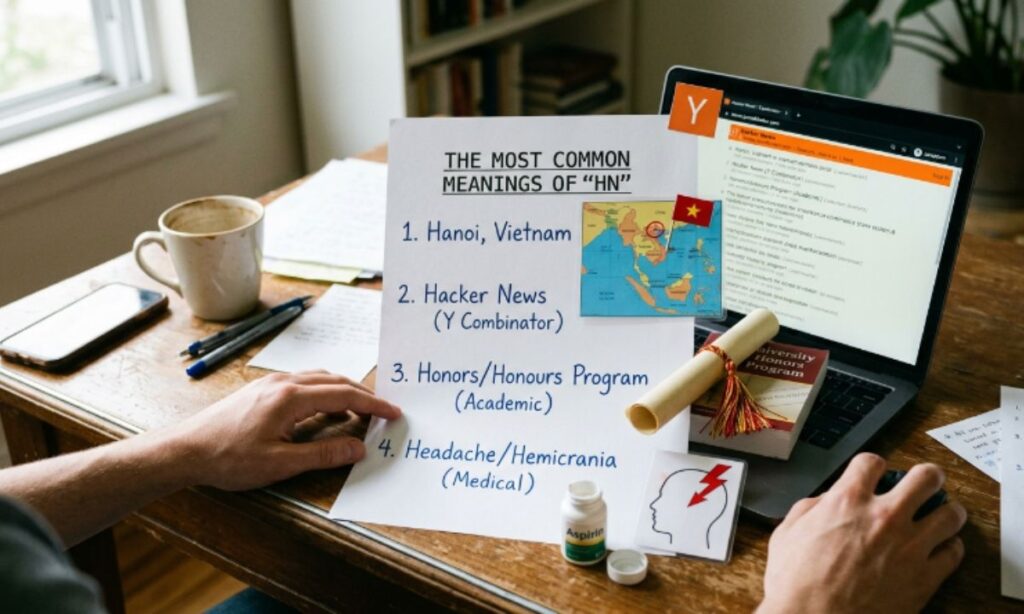
To make this genuinely useful (not just theoretical), here’s a breakdown of the meanings people actually intend when they type “hn,” ranked roughly from most to least common in everyday texting.
1. A Written “Hmm” (Thinking or Considering)
This is the most frequent real-world use. Someone sends “hn” when they’re processing what you said, deciding how to respond, or genuinely unsure. It’s a placeholder for thought not silence, not disinterest, just processing.
2. Casual Acknowledgment (“Okay” / “Got It”)
Especially common in fast-paced group chats or when someone is busy. It functions like a nod in real life, confirming they saw your message without committing to a longer reply.
3. “Hell No” (Firm Rejection)
In more expressive or slang-heavy circles, “hn” is shorthand for “hell no,” a blunt, sometimes humorous way to reject an idea, invitation, or suggestion. Tone here does the heavy lifting: capitalized “HN” with no punctuation often reads sharper than lowercase “hn” with a laughing emoji attached.
4. Mild Disinterest or Emotional Distance
When “hn” is the entire response to something emotionally significant, someone venting, sharing news, or asking a real question, it can come across as dismissive, even if that’s not the intent. This is the version most likely to cause hurt feelings or arguments.
5. A Flirty, Teasing Half-Answer
In more playful or flirtatious conversations, “hn” can function like a smirk in text form — a way of staying coy, drawing out the conversation, or reacting to something without fully revealing how you feel.
6. A Sound Effect (Manga, Fiction, RP Chats)
In fan fiction, roleplay chats, and manga/anime-adjacent spaces, “hn” is frequently used to represent a short grunt, gasp, or vocalized reaction a character makes closer to onomatopoeia than to slang with semantic meaning.
Read More: 555 Angel Number Meaning: Love, Twin Flame, Career & Spiritual Significance
How “hn” Is Used in Real Conversations
Context is everything with “hn.” Here’s how it plays out across common everyday scenarios:
| Scenario | Message Exchange | Likely Meaning |
| Casual update | “Running 10 mins late” → “hn” | Simple acknowledgment |
| Invitation | “Wanna get food later?” → “hn, maybe” | Undecided, mild interest |
| Bold suggestion | “We should skip work tomorrow” → “hn” | Amused, non-committal “we’ll see” |
| Direct ask | “Can I borrow $50?” → “hn.” | Likely a soft or firm “no” |
| Emotional share | “I had a really rough day” → “hn” | Risky — can read as cold/dismissive |
| Flirty banter | “I miss you” → “hn 🙂” | Playful, coy acknowledgment |
| Shocking news | “She actually said that to him?” → “hn, wow” | Reactive, processing surprise |
A useful rule of thumb: the more emotionally loaded the original message, the more “hn” needs supporting context (emojis, punctuation, or a follow-up) to avoid being misread.
Punctuation and Capitalization Change Everything
- “hn” (lowercase, no punctuation) → usually soft, casual, low-stakes
- “Hn.” (capitalized with a period) → firmer, more final, can feel blunt
- “HN!!” (all caps, exclamation) → strong reaction, often “hell no” energy
- “hn~” or “hn lol” → playful, teasing, clearly not meant to offend
- “hn…” (trailing dots) → hesitant, uncertain, possibly uncomfortable
This is the same pattern you see with almost all short-form text slang: the letters barely change, but formatting completely shifts the emotional temperature.
Is “hn” Rude, Flirty, or Offensive?
Short answer: it depends entirely on context, and it’s rarely offensive on its own.
Here’s a more honest breakdown:
When it can feel rude or dismissive:
- Sent as the only reply to something emotional or important
- Used repeatedly instead of actually engaging in a conversation
- Sent in a professional or formal setting where more effort is expected
When it’s playful or flirty:
- Used in ongoing back-and-forth banter with emojis or teasing follow-ups
- Sent in response to a compliment or something suggestive
- Paired with a tilde (~), a laughing emoji, or a wink
When it’s completely neutral:
- Quick acknowledgments in fast group chats
- Responses to low-stakes logistical messages (“running late,” “on my way,” etc.)
- Habitual texting style for people who default to short replies generally
Genuinely offensive “hn” usage is rare. It’s not a slur, insult, or aggressive term. The discomfort it causes is almost always about perceived effort and emotional availability it can feel like the other person isn’t fully engaging, even when that’s not their intention.
How to Respond When Someone Says “hn”
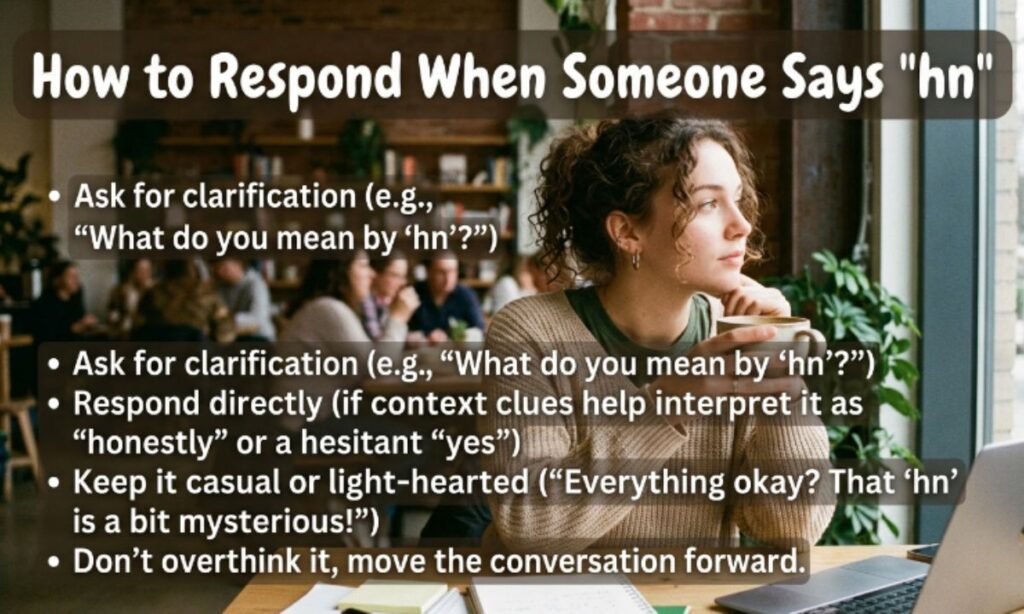
If you’re unsure how to read or respond to an “hn,” these approaches work well across most situations:
- Look at what you just sent. If it was low-stakes, don’t overanalyze; just continue the conversation normally.
- Check their general texting style. Some people default to short replies with everyone, not just you; it’s a personality trait, not a signal.
- If it followed something emotional, gently check in. A simple “everything okay?” invites clarity without accusation.
- Mirror the energy if it’s casual. Match a short “hn” with your own brief reply rather than over-explaining.
- Ask directly if you genuinely can’t tell. “Wait, is that a yes or no? 😅” is a normal, low-pressure way to get clarity.
- Don’t assume the worst by default. Because “hn” is so ambiguous, jumping straight to “they’re mad at me” is often projection rather than accurate reading.
Common Misunderstandings About “hn”
- “It always means someone is annoyed.” False — it’s most often neutral or simply a thinking pause.
- “It’s the same as being ignored.” Not quite an actual ignored message gets no reply at all; “hn” is still a response, just a minimal one.
- “It only means ‘hell no.'” Also false, that’s one of several meanings, and often the least common in everyday chat compared to the “hmm” / acknowledgment use.
- “It’s always sarcastic.” Sarcasm requires context and tone markers; plain “hn” by itself is usually sincere, just brief.
- “Only certain age groups use it.” While it’s especially common among younger texters and gamers, it shows up across group chats, professional Slack messages (as a quick “noted”), and casual family texts too.
Similar Slang Terms You Should Know
Understanding “hn” gets easier when you see it next to related short-form expressions:
| Term | Meaning | How It Differs From “hn” |
| hmm | Thinking, considering | More clearly “thinking,” less ambiguous |
| k | Simple acknowledgment | Can feel colder/more final than “hn” |
| idk | “I don’t know” | Explicit uncertainty rather than a sound |
| meh | Indifference | Clearly signals low enthusiasm |
| lol | Amusement marker | Adds levity; often softens a message |
| eh | Mild indifference or “so-so” | Similar vague energy to “hn” |
| istg | “I swear to god” | Emphasis/emotion, not acknowledgment |
| omw | “On my way” | Purely functional, no ambiguity |
“Hn” sits closest to “hmm” and “eh” on this list all three are vocal-sound-based texting shorthand rather than true acronyms, which is exactly why they carry tone instead of a fixed definition.
When You Should Avoid Using “hn”
There are a few situations where sending “hn” is more likely to cause friction than save time:
- Responding to something emotionally serious: grief, stress, a big life update, or someone venting deserves a real sentence, not a sound.
- Professional or formal messages: in work emails, client chats, or first-time professional contact, “hn” reads as underprepared or careless.
- Early-stage relationships or new friendships: before someone knows your texting style, ambiguity can easily be misread as disinterest.
- Conflict or disagreement conversations: during an argument, a minimal “hn” can escalate tension rather than de-escalate it.
- When someone directly asks a yes/no question, “hn” doesn’t actually answer the question, which can feel evasive.
In these moments, a few extra words go a long way toward avoiding unnecessary misunderstandings.
Frequently Asked Questions
What does “hn” mean from a girl?
It typically means the same as it does from anyone else thinking, casual acknowledgment, or mild interest though in flirty exchanges it can also read as playful or coy.
Is “hn” the same as “hmm”?
They’re closely related; “hn” is essentially a shorter, more clipped written version of the same thinking or considering sound.
Does “hn” mean someone is mad at me?
Not usually it’s more often a neutral or low-effort reply than a sign of anger, especially if there’s no other context suggesting upset.
What does “hn” mean on Snapchat or Instagram?
The meaning stays consistent across platforms; it usually reflects acknowledgment, hesitation, or a quick reaction rather than anything platform-specific.
Can “hn” mean “yes”?
Sometimes, especially when paired with a nod-like tone in conversation, but it’s more accurately read as “I hear you” than a confirmed “yes.”
Is it okay to send “hn” to your boss?
It’s best avoided in professional messages, since it can come across as careless or under-engaged compared to a clear, complete reply.
Why do people use “hn” instead of typing more?
It’s fast, low-effort, and mirrors a natural spoken sound — useful for quick acknowledgments without slowing down a conversation.
What’s the difference between “hn” and “hn.”?
Adding a period tends to make the reply feel more final, blunt, or firm, while a plain “hn” without punctuation usually feels softer and more casual.
Final Thoughts
“Hn” is one of those texting expressions that proves how much meaning can hide inside just two letters. It’s not a rigid acronym with one locked-in definition — it’s a written stand-in for a sound, which means tone, timing, punctuation, and relationship context do almost all the work.
Most of the time, it’s harmless: a thinking pause, a quick nod, a casual “got it.” Occasionally, it’s a firm “no.” Rarely, it’s meant to be cold or dismissive. The key isn’t memorizing a single meaning it’s reading the moment around it.
Next time “hn” shows up in your messages, you’ll know exactly how to read it and exactly how to respond without the overthinking spiral.
